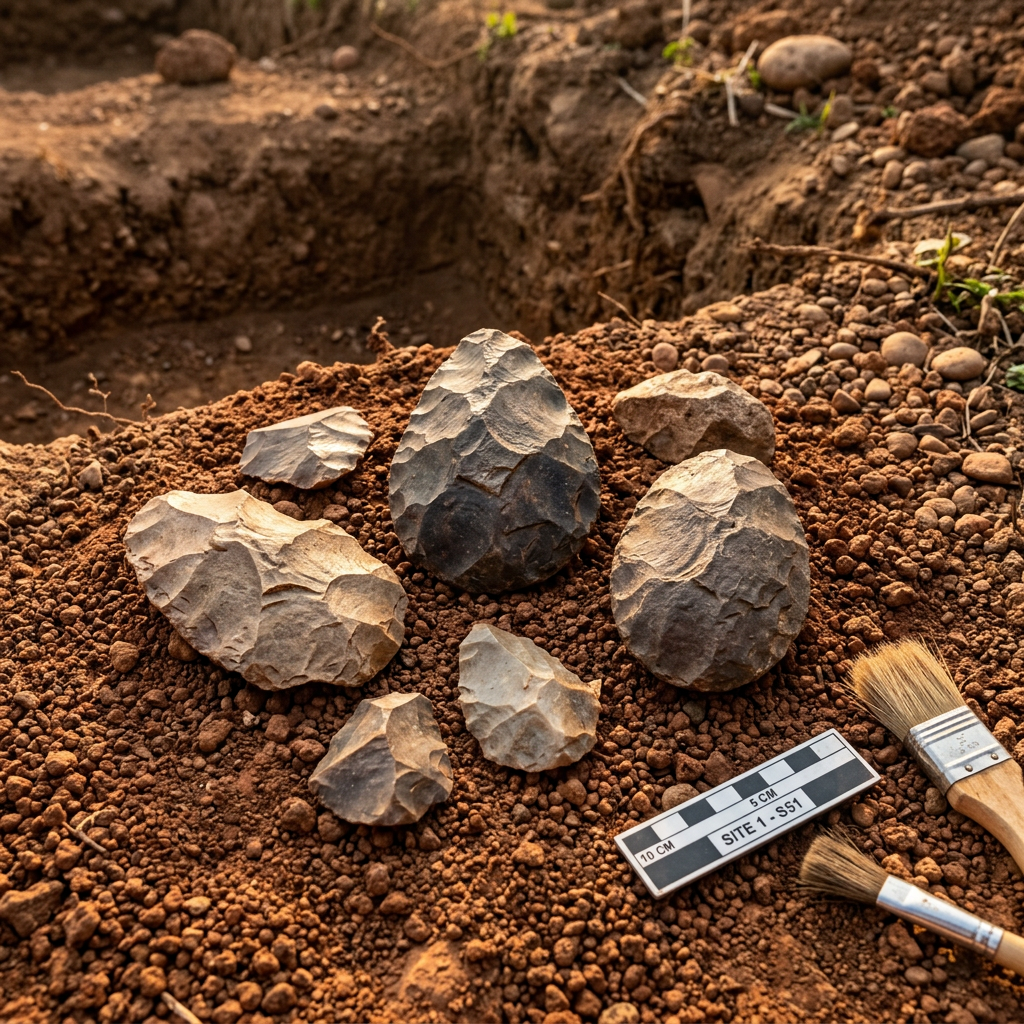
A recent road construction project in the Deogarh district of Odisha has inadvertently opened a gateway into the distant past. During the building of a bypass near the Reamal tehsil, workers unearthed a cache of ancient stone tools buried within a laterite hillock. A joint team of archaeologists from the Archaeological Survey of India (ASI) and Government Autonomous College, Sundargarh, was dispatched to examine the site, subsequently confirming that the artifacts date back to the Middle Palaeolithic period, approximately 60,000 to 70,000 years ago.
The collection includes approximately 30 distinct tools, such as hand axes, Levallois cores, flakes, awls, and discoids. These artifacts were crafted from coarse quartzite and quartz, materials commonly utilized by prehistoric humans for hunting, butchering, and gathering. The discovery of Levallois technology—a sophisticated method of stone knapping—indicates that early settlers in western Odisha possessed advanced cognitive and technical skills far earlier than previously documented for this specific region.
According to archaeologists Sakir Hussain and Dibishada Brajasundar Garnayak, this find represents the first concrete evidence of Middle Palaeolithic human activity in Deogarh. The site's stratigraphy suggests a continuous presence of early humans who utilized the local landscape's natural resources. Researchers are now calling for a more systematic excavation of the area to determine if these tools represent a permanent settlement or a migratory camp used by early Homo sapiens or their ancestors as they moved across the Indian subcontinent.