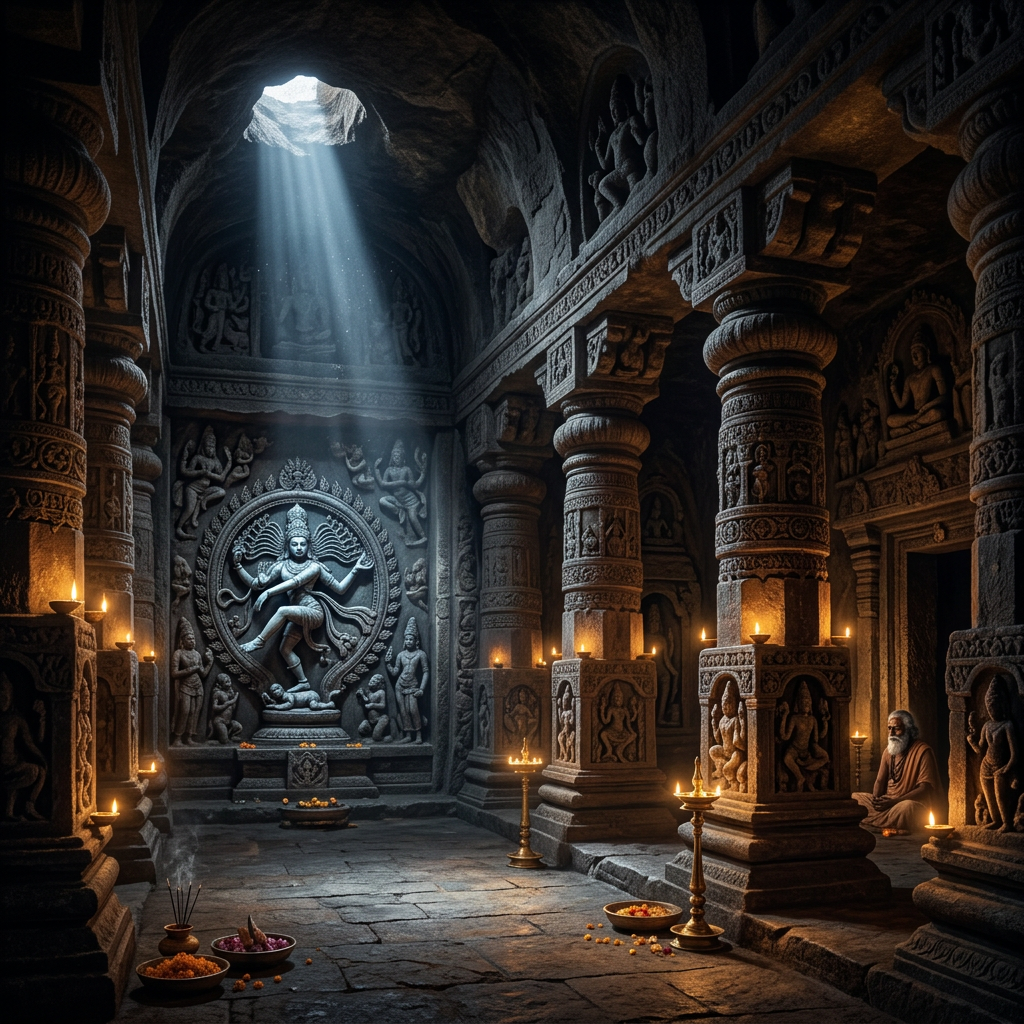
A multidisciplinary study involving the Indian Institute of Astrophysics and the ASI has confirmed that the 6th-century Chalukyan rock-cut temples in Badami, Karnataka, functioned as a sophisticated lunar observatory. Researchers discovered that a specific circular window in Cave 3 is precisely aligned to capture the moon's light during the Major Lunar Standstill, an astronomical event that occurs only once every 18.6 years. This indicates a level of mathematical and astronomical precision previously underestimated in Early Chalukyan architecture.
The study also highlights a series of rock carvings depicting the 'Nakshatras' (lunar mansions) that correspond to specific alignments within the cave complex. By using archaeo-astronomy software to reconstruct the 6th-century sky, the team proved that the temple's placement was not merely aesthetic but served as a permanent calendar for calculating Vedic ritual dates and seasonal cycles. This find reinforces the concept of Vedic Science as an applied discipline in ancient Indian temple planning.
Restoration experts are now working to ensure that the specific stone pillars and carvings involved in these alignments are protected from further weathering. This discovery is expected to lead to a re-evaluation of other rock-cut sites across India, such as Ellora and Ajanta, for similar astronomical orientations. It provides tangible evidence of the deep integration of cosmology and architecture in Sanatan heritage.