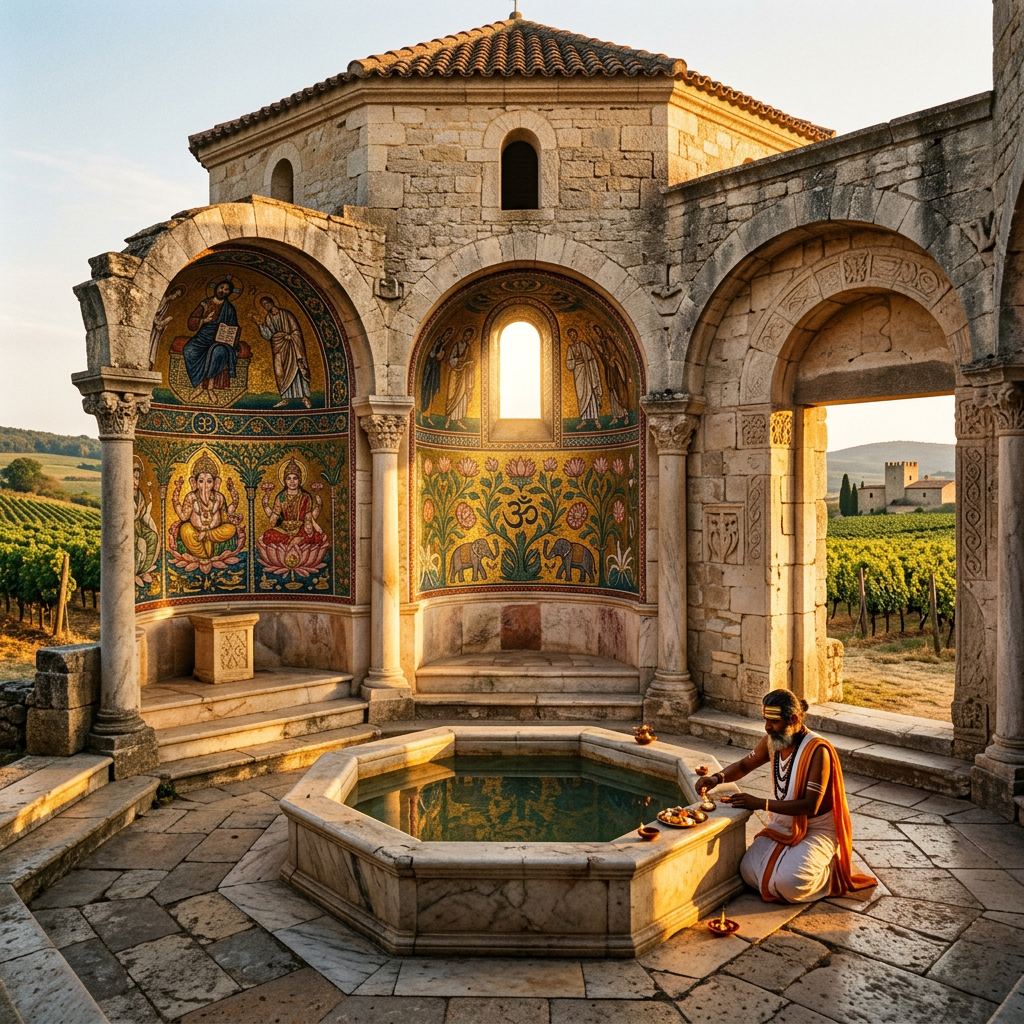
An exceptionally well-preserved 5th-century Christian baptistery has been discovered beneath a vineyard in the Auvergne region of France. The octagonal structure, built with local volcanic stone, remains almost entirely intact, including its central marble-lined immersion pool. This discovery provides a rare archaeological link between the late Roman Empire and the early Merovingian period.
The walls of the baptistery are adorned with stunning mosaics that demonstrate a unique cultural synthesis. Biblical narratives, such as the baptism of Christ, are depicted alongside traditional Gallo-Roman floral and geometric patterns, suggesting a gradual transition of religious identity rather than an abrupt cultural shift.
Researchers from the University of Clermont-Ferrand noted that the site includes a sophisticated heating system (hypocaust) used to warm the baptismal waters during the winter months. This find highlights the architectural continuity of Roman engineering being repurposed for the needs of the burgeoning Christian Church in rural Gaul.