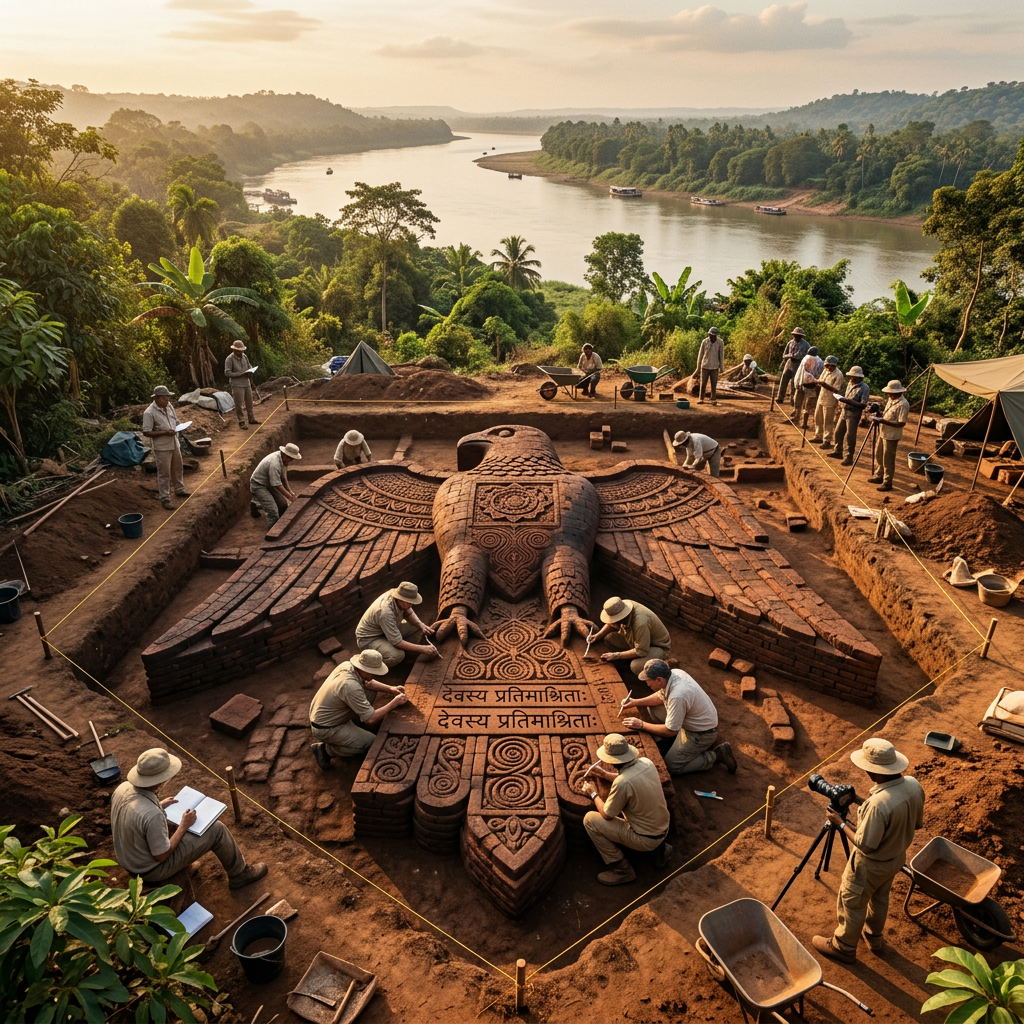
In a groundbreaking discovery near the banks of the Brahmaputra River, archaeologists have unearthed a massive brick-and-stone altar complex dating back to the 1st century BCE. This site, identified as a Syena Chiti or falcon-shaped sacrificial altar, provides the first physical evidence of sophisticated Vedic ritualism in the far northeast of India during the late Iron Age. The structure is remarkably preserved, featuring intricate geometry that aligns precisely with the winter solstice sunrise.
The excavation revealed layers of specialized bricks, some inscribed with early Brahmi characters, detailing the names of donors and the specific cosmic deities the altar was dedicated to. Researchers from the Northeast Heritage Sentinel report that the site's layout mirrors the mathematical principles described in the Sulba Sutras, ancient texts dedicated to altar construction. This suggests a much earlier and deeper penetration of Vedic culture into the Assam valley than previously recorded in historical chronicles.
Surrounding the main altar, the team discovered charred remains of grains and ceramic offerings, which are currently undergoing isotopic analysis. These findings point to a thriving agrarian community with advanced knowledge of metallurgy and astronomy.
- The altar measures over 15 meters in wingspan.
- Unique drainage channels suggest ritual libations were managed with high engineering precision.
- Presence of semi-precious stone beads indicates trade links with the Gangetic plains.