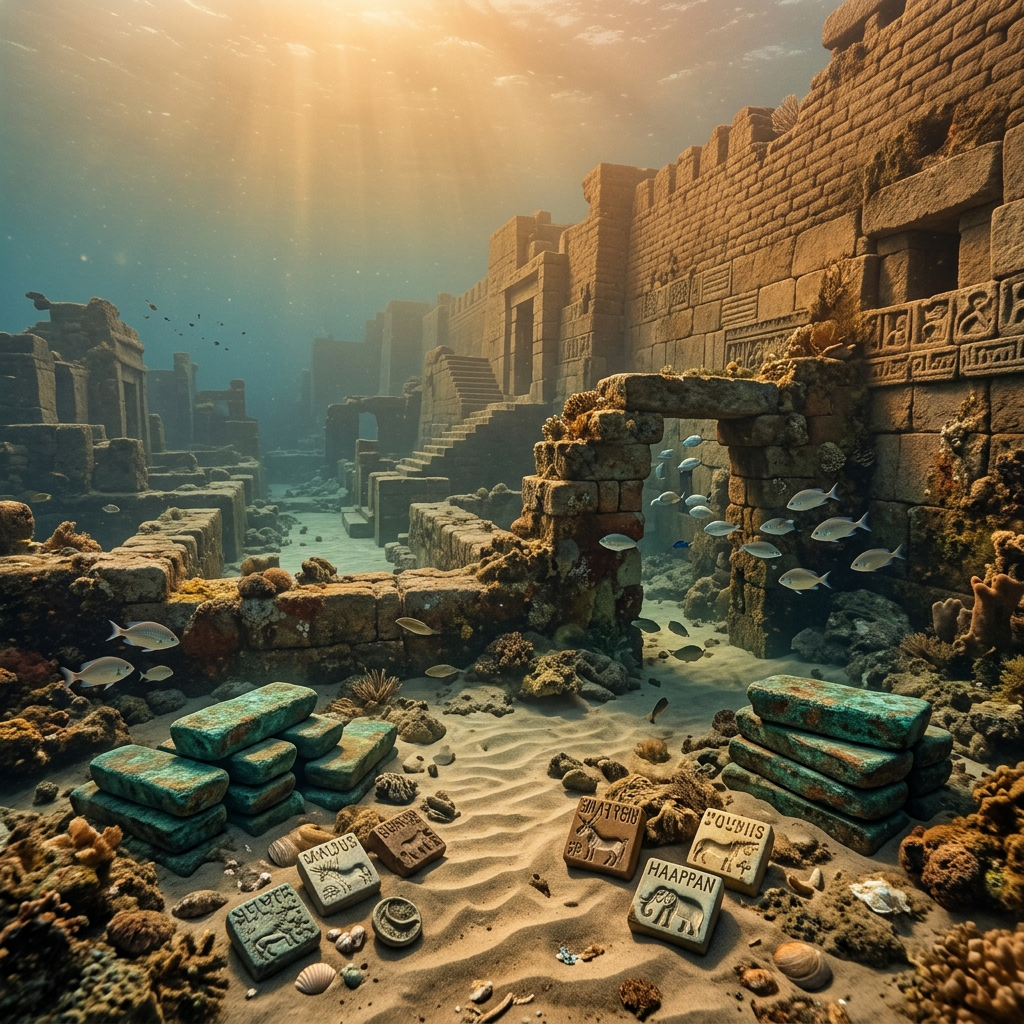
Deep-sea exploration using high-resolution sonar and ROVs has identified a sprawling submerged urban center off the coast of the Dhofar region in Oman. Dating to approximately 2500 BCE, the site spans over 100 hectares and features massive stone foundations of warehouses, residential blocks, and a monumental harbor wall. This 'lost city' is believed to be a primary hub of the Magan civilization, which served as the principal supplier of copper to the empires of Mesopotamia and the Indus Valley.
The most striking find at the site is a large central plaza containing hundreds of 'bun-shaped' copper ingots, many of which bear Harappan-style seals. This provides definitive proof of a high-volume, organized maritime trade network between the Arabian Peninsula and the Indian subcontinent. The architectural layout of the city shows a blend of local Omani masonry and Indus-style urban planning, including standardized street widths and sophisticated drainage channels.
Researchers suggest that the city was likely submerged due to a combination of rapid sea-level rise and a catastrophic tectonic event. The site remains largely undisturbed, offering a 'time capsule' of Bronze Age maritime logistics. Artifacts recovered so far include lapis lazuli from Afghanistan, carnelian beads from Gujarat, and Mesopotamian bitumen, highlighting the city's role as a global nexus of the ancient world.