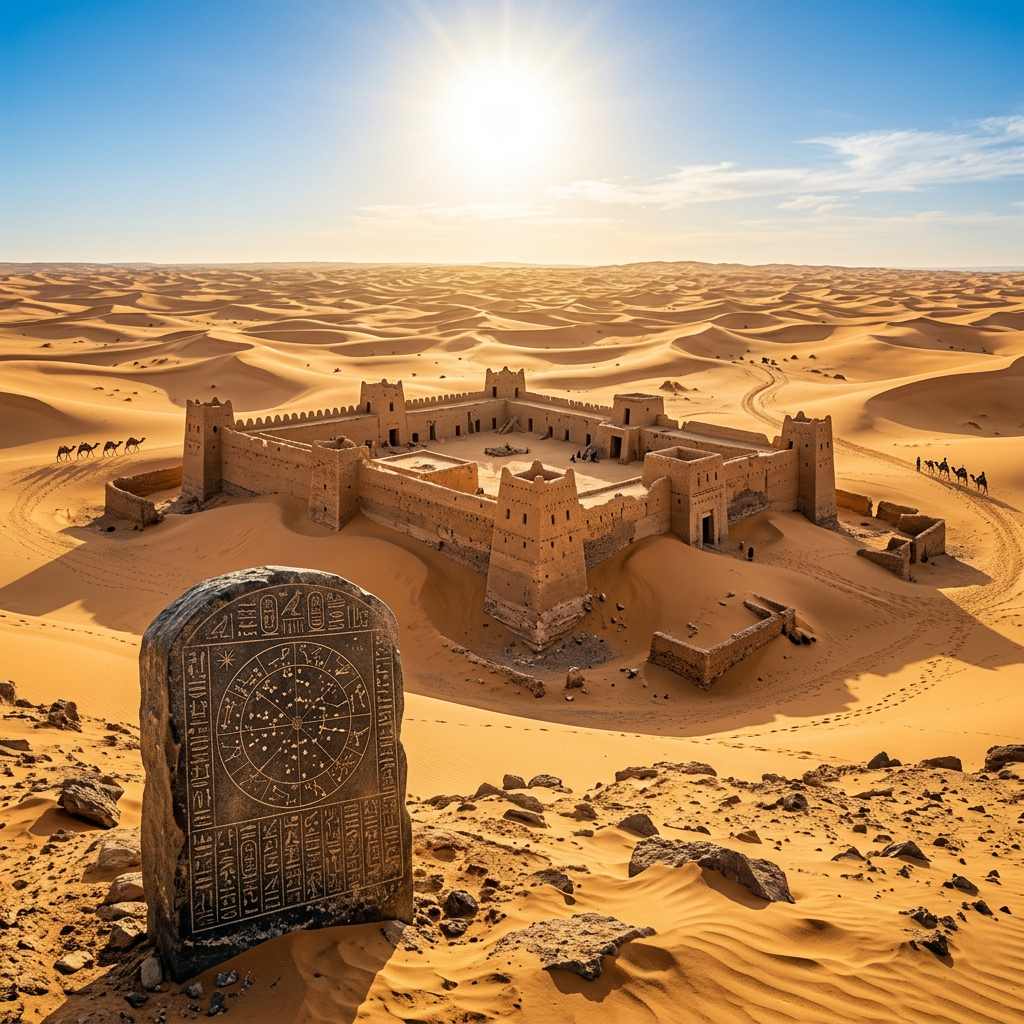
A joint international mission has identified the ruins of a Middle Kingdom fortified trading post located deep in the Western Desert, far from the traditional Nile-corridor settlements. Using Synthetic Aperture Radar (SAR) to penetrate the sand dunes, the team uncovered a mud-brick fortress dating to the reign of Senusret III, specifically designed to control "The Golden Path"—a forgotten trade route connecting the Nile to the gold-rich regions of the central Sahara.
The site has yielded an incredible array of artifacts, including Ametrine jewelry and specialized "desert survival kits" consisting of copper mirrors, water storage jars with early filtration layers, and inscribed navigational stelae. These stelae provide astronomical coordinates for the next wells, proving the Egyptians had mapped the deep desert with mathematical precision as early as 1850 BCE.
This find effectively rewrites the economic history of the Middle Kingdom, showing that Egyptian influence and resource extraction extended hundreds of miles further west than previously recorded. The fortress also served as a diplomatic hub, as evidenced by pottery from indigenous Saharan cultures found within the commander's quarters.