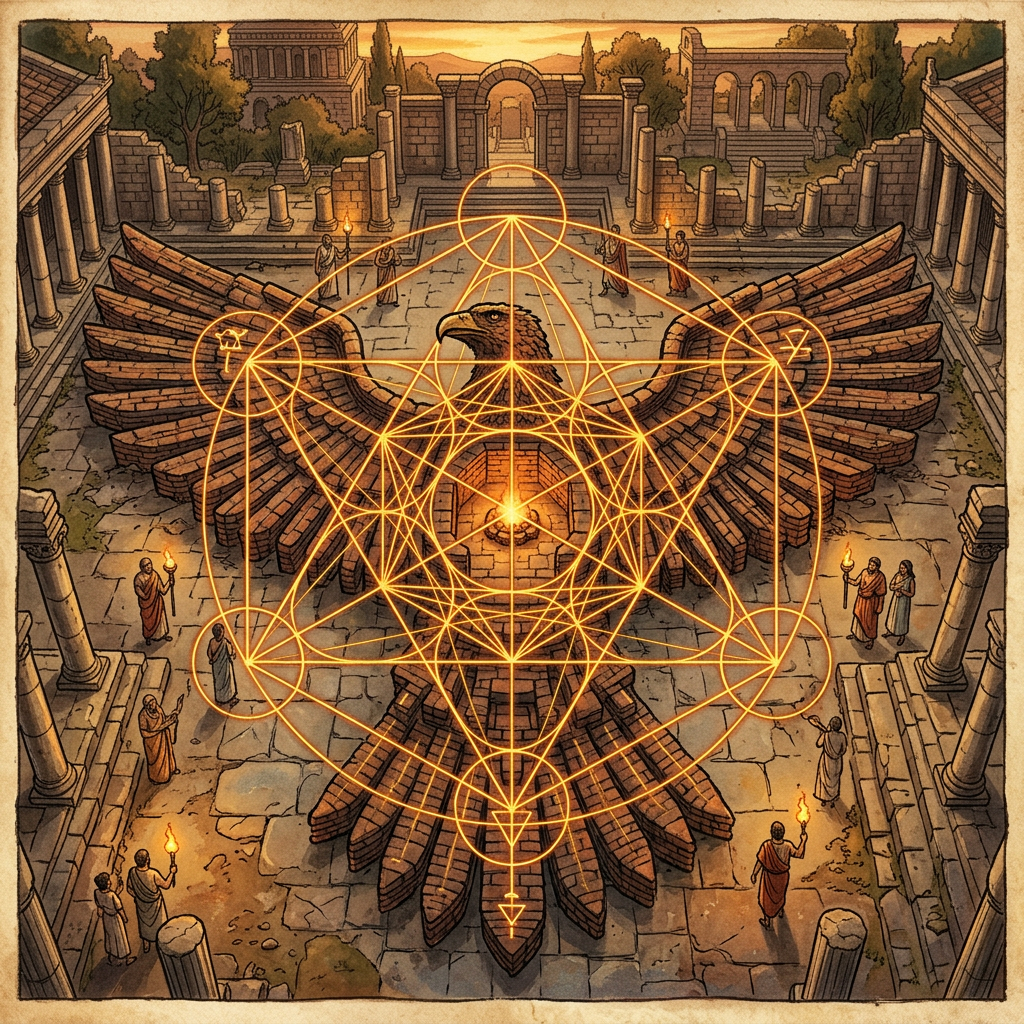
A new interdisciplinary study by mathematicians and archaeologists has analyzed the brick layouts of recently excavated ritual altars in Vidisha, Madhya Pradesh. The research demonstrates that the construction of these 1st-century BCE altars strictly followed the geometric principles of the Shulba Sutras, employing complex transformations of area and early versions of the Pythagorean theorem.
The study reveals that the Vedic practitioners used a system of progressive approximations to solve the problem of 'squaring the circle' with remarkable precision. These physical remains serve as a 'mathematical archive,' proving that advanced algebraic and geometric concepts were not just theoretical in ancient India but were applied with architectural rigor in sacred constructions.