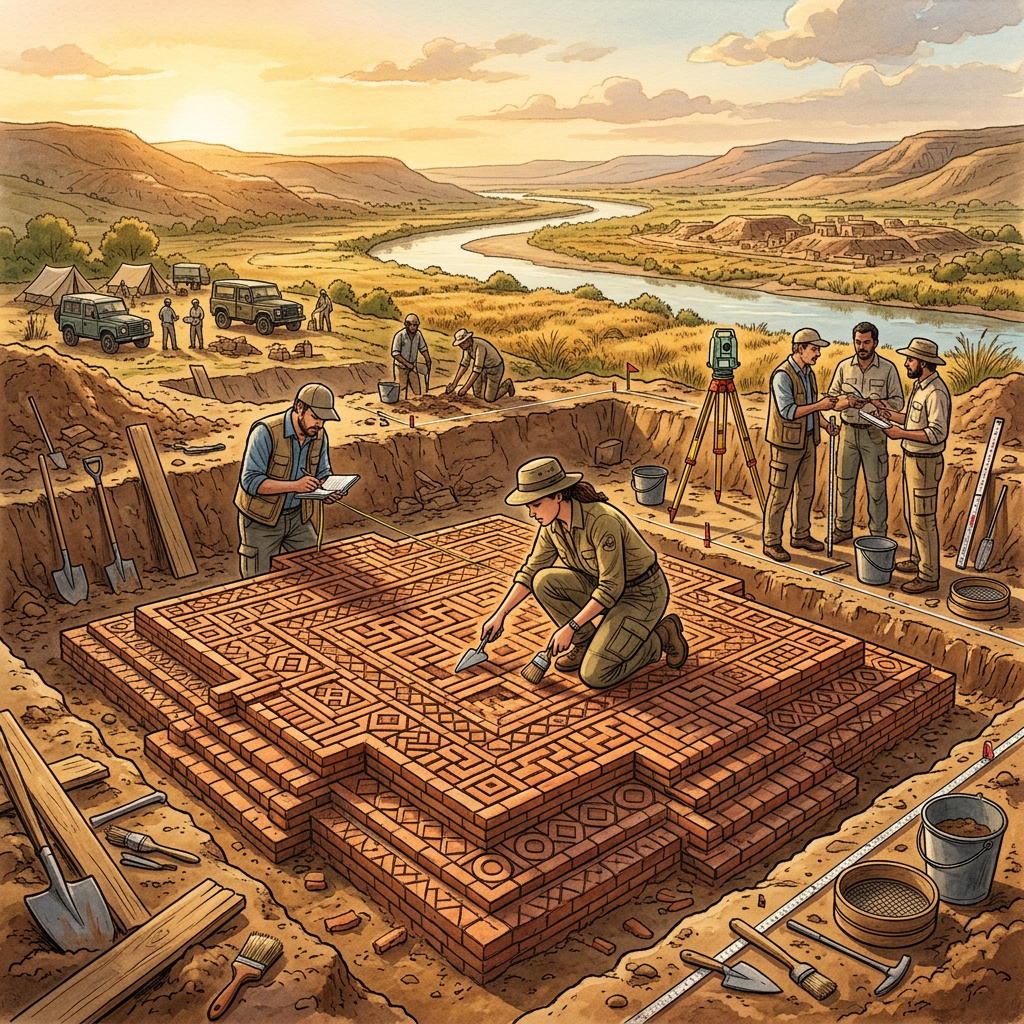
Archaeologists in Madhya Pradesh's Narmada Valley have uncovered a remarkably preserved 3rd-century BCE fire altar, or Agni-Chiti. The structure, built with standardized fired bricks, follows the geometric prescriptions found in the ancient Sulba Sutras, demonstrating a high degree of mathematical precision in late Vedic-period ritual architecture.
The excavation team from the Archaeological Survey of India also found carbonized remains of organic offerings, including sesame seeds and grains, which are currently undergoing isotopic analysis. This discovery provides crucial physical evidence for the continuity of Vedic traditions into the early historical period, highlighting the sophisticated engineering used to manage ritual heat and ventilation.