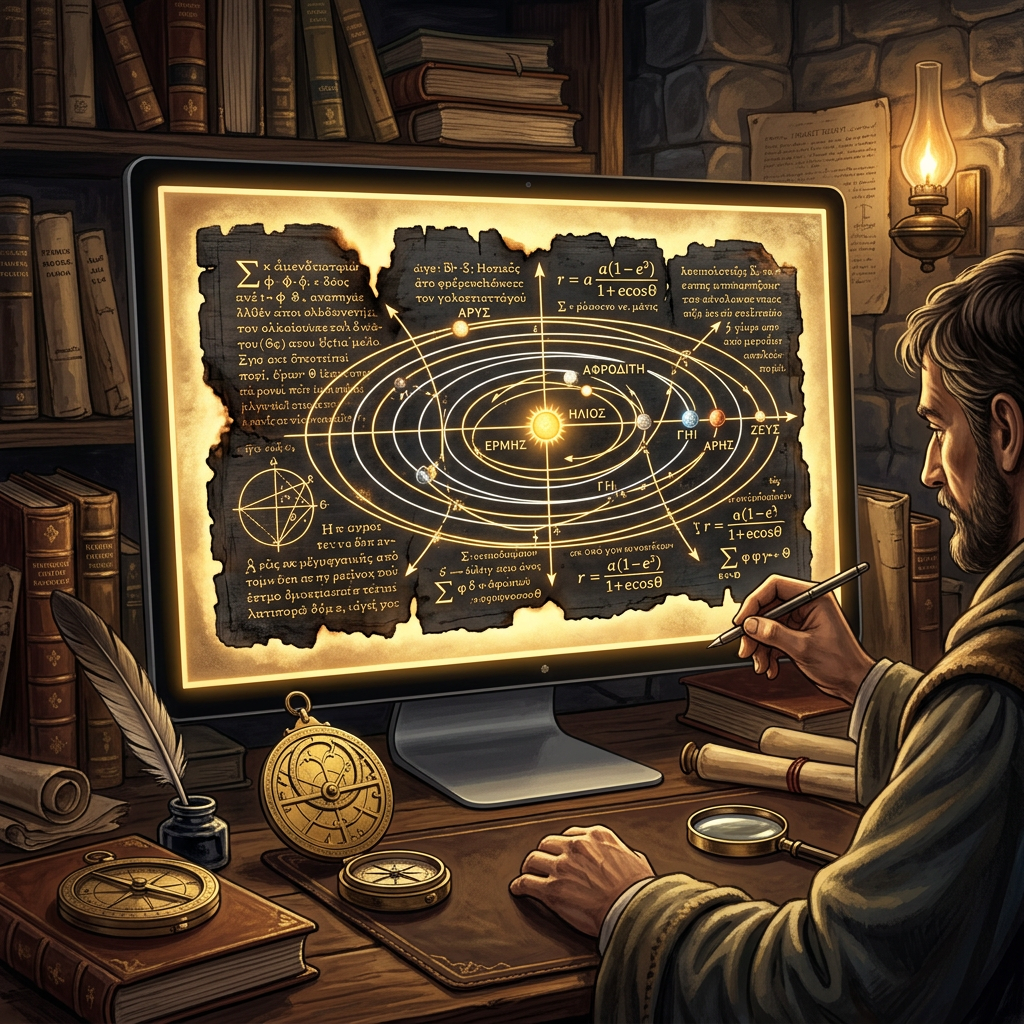
In a major victory for computational linguistics, an AI model trained on early Brahmi scripts has successfully deciphered a series of 5th-century Sanskrit fragments recovered from the Khotan region. The manuscripts, which were previously considered undecipherable due to extensive charring and ink-fading, contain sophisticated mathematical tables for calculating planetary perturbations (the gravitational effects of planets on each other's orbits).
The text, likely a lost commentary on the Paitamaha Siddhanta, uses a base-10 system to estimate the irregular motion of Jupiter and Saturn with surprising precision. Scholars at the Institute of Advanced Sanskrit Studies believe this discovery proves that Indian astronomers had developed a quantitative understanding of planetary interaction centuries before similar concepts appeared in Islamic or European science. The fragments also detail a unique 'variable-interval' method for predicting lunar eclipses.