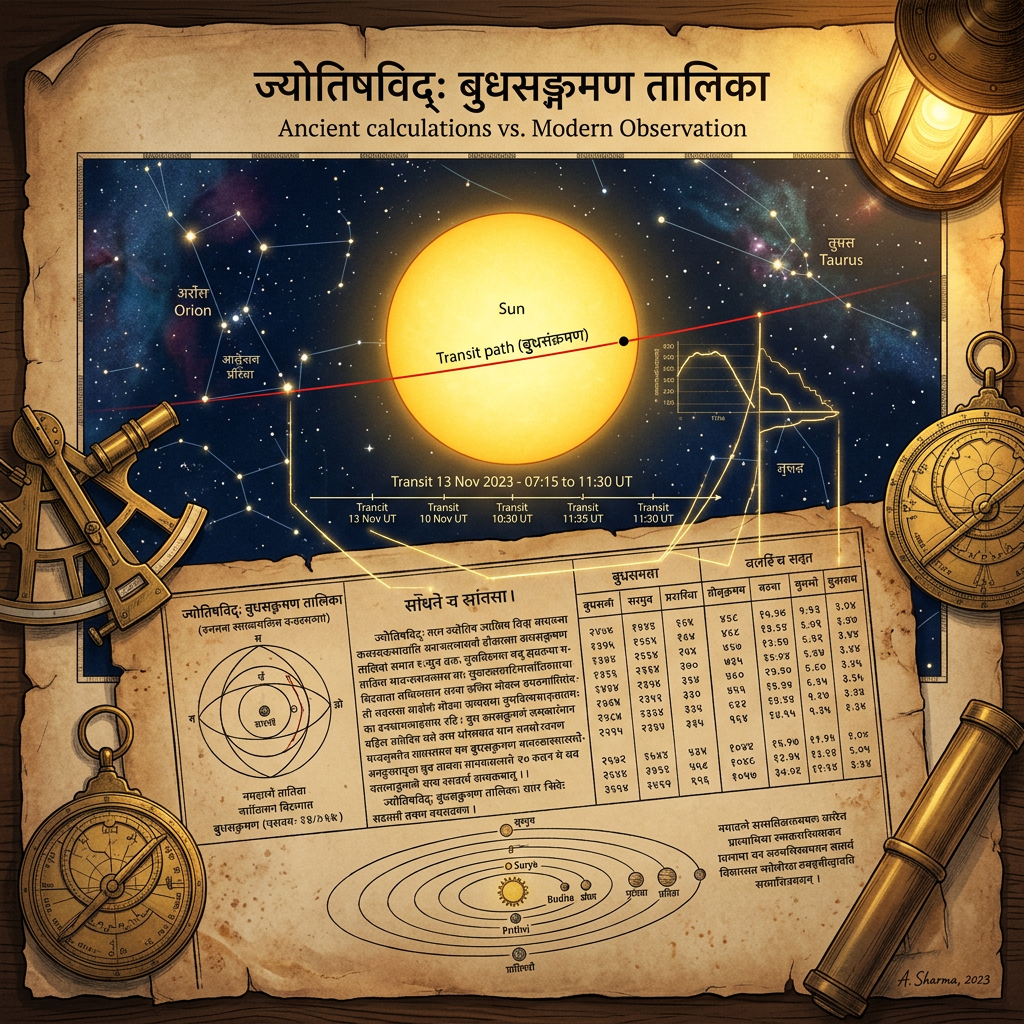
A new research paper published in the Journal of Astronomical History and Heritage has utilized advanced computational modeling to verify the accuracy of planetary tables found in a 9th-century commentary on the Surya Siddhanta. The study, led by a team of astrophysicists and Sanskrit scholars, demonstrates that ancient Indian astronomers used sophisticated iterative algorithms to account for the orbital perturbations of Mercury, achieving a level of precision previously thought impossible for the era.
The research highlights how these Suryasiddhantic models correctly predicted the transit of Mercury across the solar disk with a margin of error of less than three minutes. By reconstructing the mathematical steps detailed in the manuscript, researchers found that the ancient scholars employed a precursor to modern trigonometric interpolation, allowing them to adjust for the planet's eccentric orbit and varying velocity.