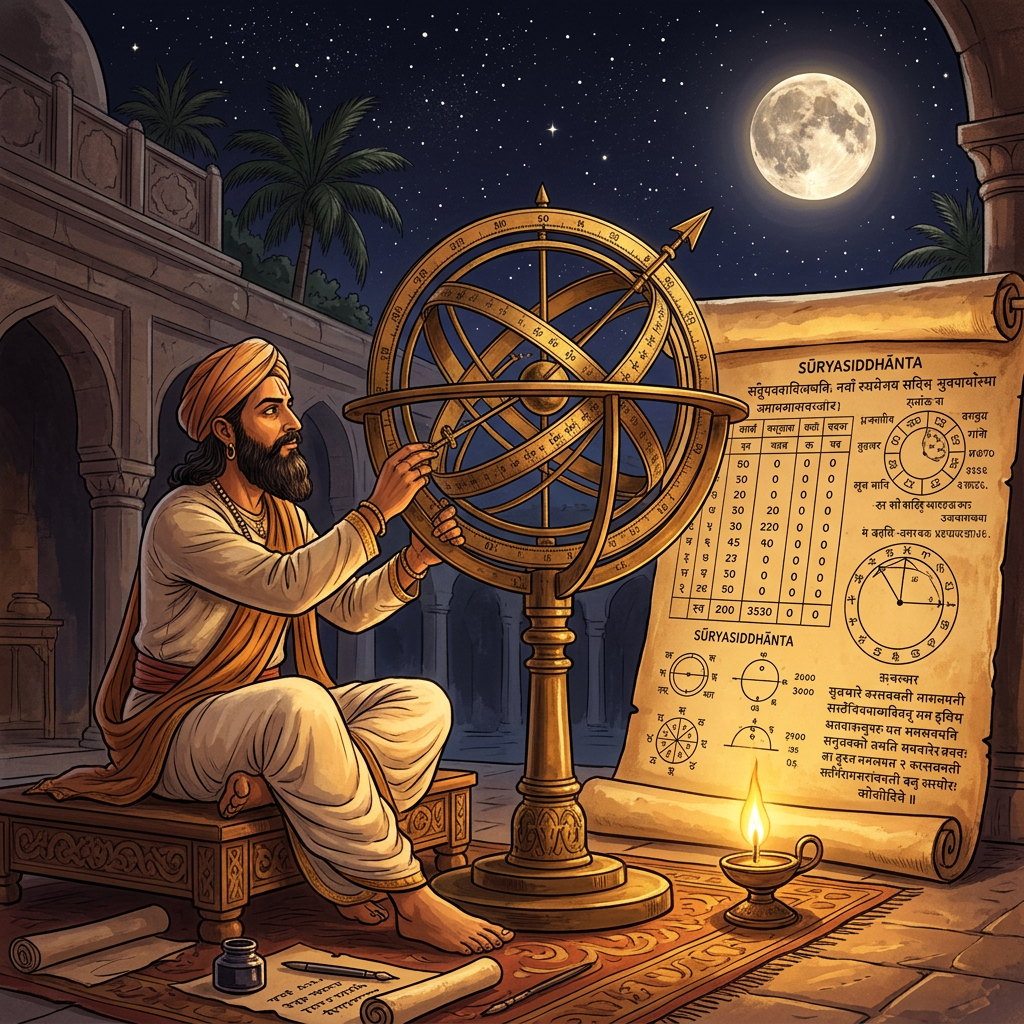
A groundbreaking study published this week in the Journal of Astronomical History and Heritage has utilized modern computational models to verify the accuracy of the Khandakhadyaka, an 8th-century astronomical treatise by the polymath Brahmagupta. The research, led by a joint team from the Indian Institute of Science and the International Astronomical Union, reveals that the algorithms used by ancient Indian astronomers to predict lunar occultations—the event where the moon hides a distant star or planet—were accurate within a margin of just a few minutes.
The study highlights how ancient scholars accounted for parallax and the varying orbital speeds of the moon using complex trigonometric functions. By comparing the historical tables with NASA's high-precision ephemeris data, the researchers found that the 6th-to-8th century models provided a sophisticated framework that rivaled contemporary observations in the Islamic and Byzantine worlds, offering new evidence for the advanced state of Vedic mathematical astronomy during the medieval period.