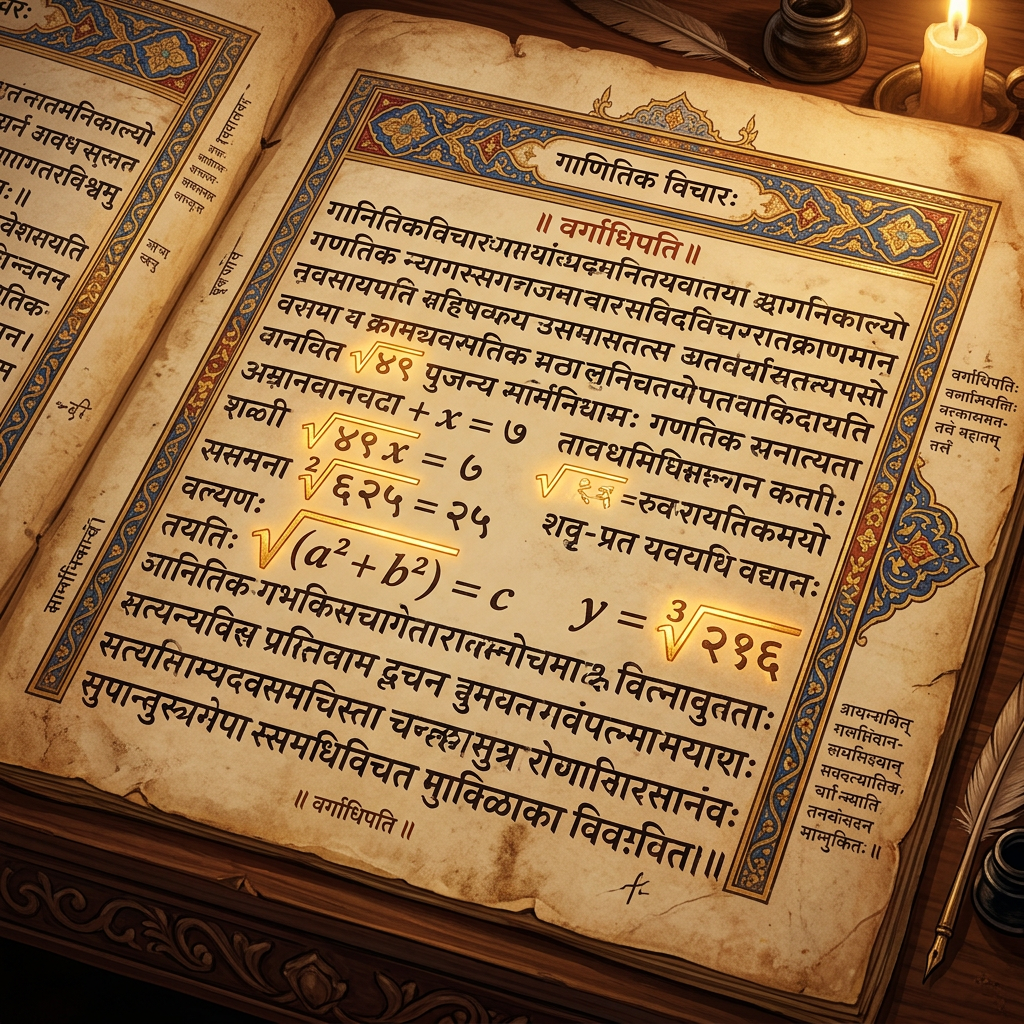
A team of historians and mathematicians has published a study in the Annals of Mathematical Science analyzing newly identified fragments of Bhaskara II’s Bijaganita. The fragments contain a series of lemmas discussing the impossibility of finding a real number for the square root of a negative quantity, suggesting a nascent understanding of imaginary numbers.
The study argues that the Kerala School predecessors were utilizing specialized notations to handle 'impossible' roots in quadratic equations as early as the 1100s. This research shifts the academic consensus on the origins of complex algebra, showing that Indian mathematicians were grappling with these abstract concepts long before their formalization in Europe during the 16th century.