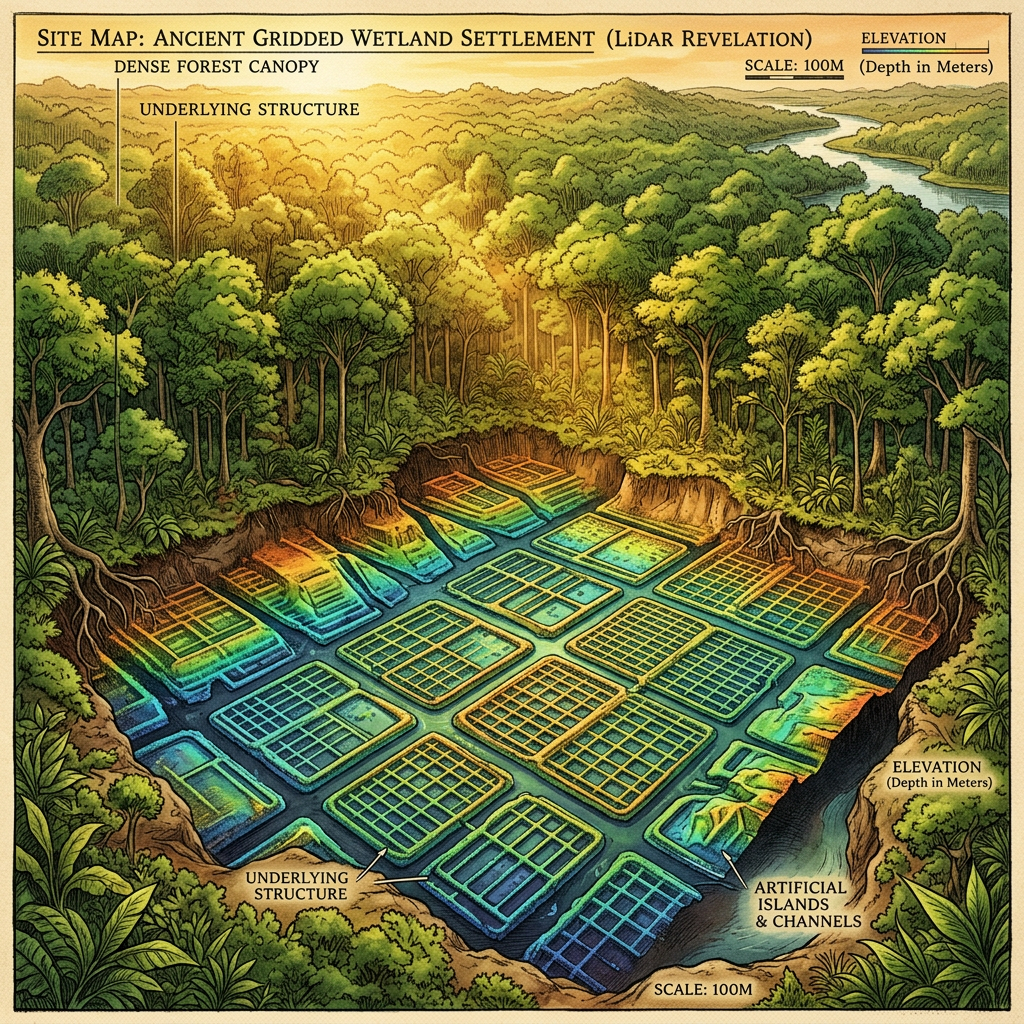
New LiDAR (Light Detection and Ranging) surveys in the Usumacinta River Basin of Mexico and Guatemala have identified a massive, previously unknown floating market complex. The technology stripped away dense jungle canopy to reveal a network of artificial islands and raised stone platforms situated in the center of a marshy lake. These structures were connected by a series of deep-water canals designed to accommodate large trade canoes.
This 'Water City' likely served as a neutral inter-regional trading hub where Highland and Lowland Maya met to exchange salt, jade, and cacao. The discovery challenges the traditional view of Mayan commerce as being primarily land-based, suggesting instead that sophisticated maritime and riverine logistics were the backbone of the Classic Maya economy.