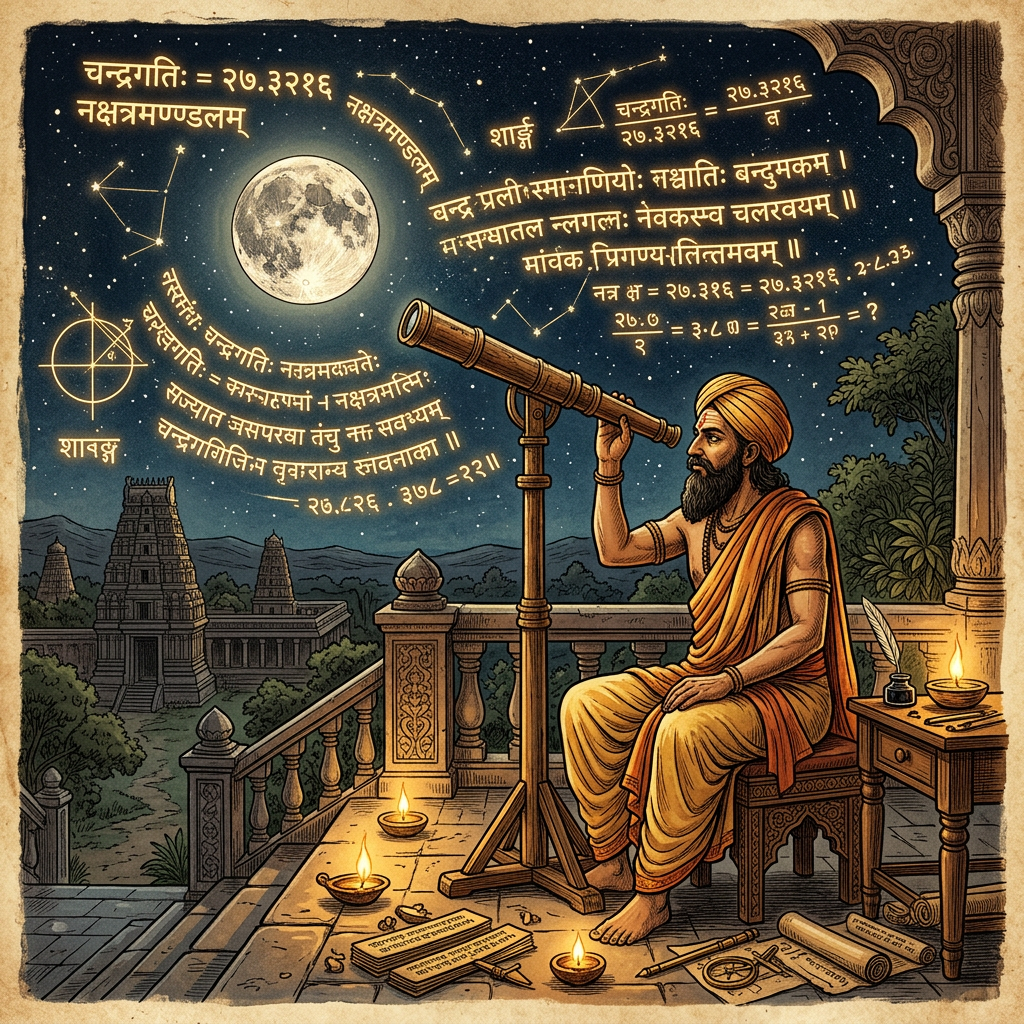
In a joint publication by the Indian Journal of History of Science and Oxford University, researchers have validated the mathematical precision of the Vatesvara-Siddhanta, a 10th-century Sanskrit astronomical treatise. By converting ancient Sanskrit verses into modern computational models, the team discovered that the text contains a refined algorithm for evection—the largest perturbation of the Moon's orbit.
The study proves that Vatesvara, the author, utilized a sophisticated iterative method to correct lunar longitudes, achieving a degree of accuracy that was not matched in European astronomy until the late 16th century. This research highlights the deep algorithmic roots of Vedic astronomy and its capacity for long-term predictive modeling of celestial bodies.