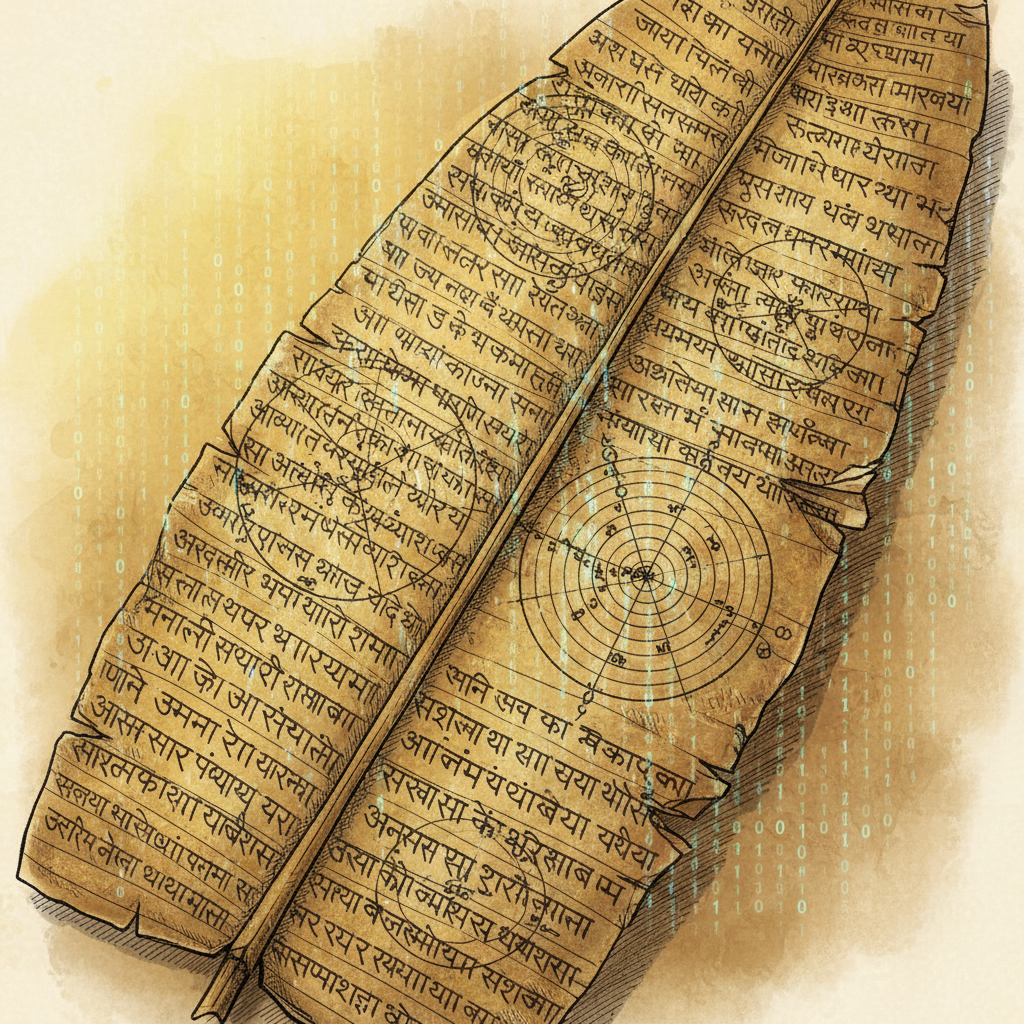
A breakthrough study published in the Journal of Astronomical History and Heritage has utilized advanced machine learning models to analyze fragmentary 10th-century manuscripts of the Siddhanta Shekhara by Shripati. The research reveals that ancient Indian astronomers employed sophisticated numerical methods and iterative algorithms to predict planetary conjunctions with a precision previously thought to have emerged centuries later. The AI identified recurring mathematical patterns that suggest a deep understanding of celestial mechanics and orbital velocities.
The study highlights how these ancient scholars utilized non-linear interpolation techniques to account for the varying speeds of planets. By digitizing and processing hundreds of palm-leaf fragments, the research team was able to reconstruct lost portions of the text, providing new insights into the computational rigors of the medieval Indian astronomical tradition. This discovery challenges the conventional timeline of mathematical development in the pre-modern world, suggesting a highly developed school of numerical analysis in the Indian subcontinent.