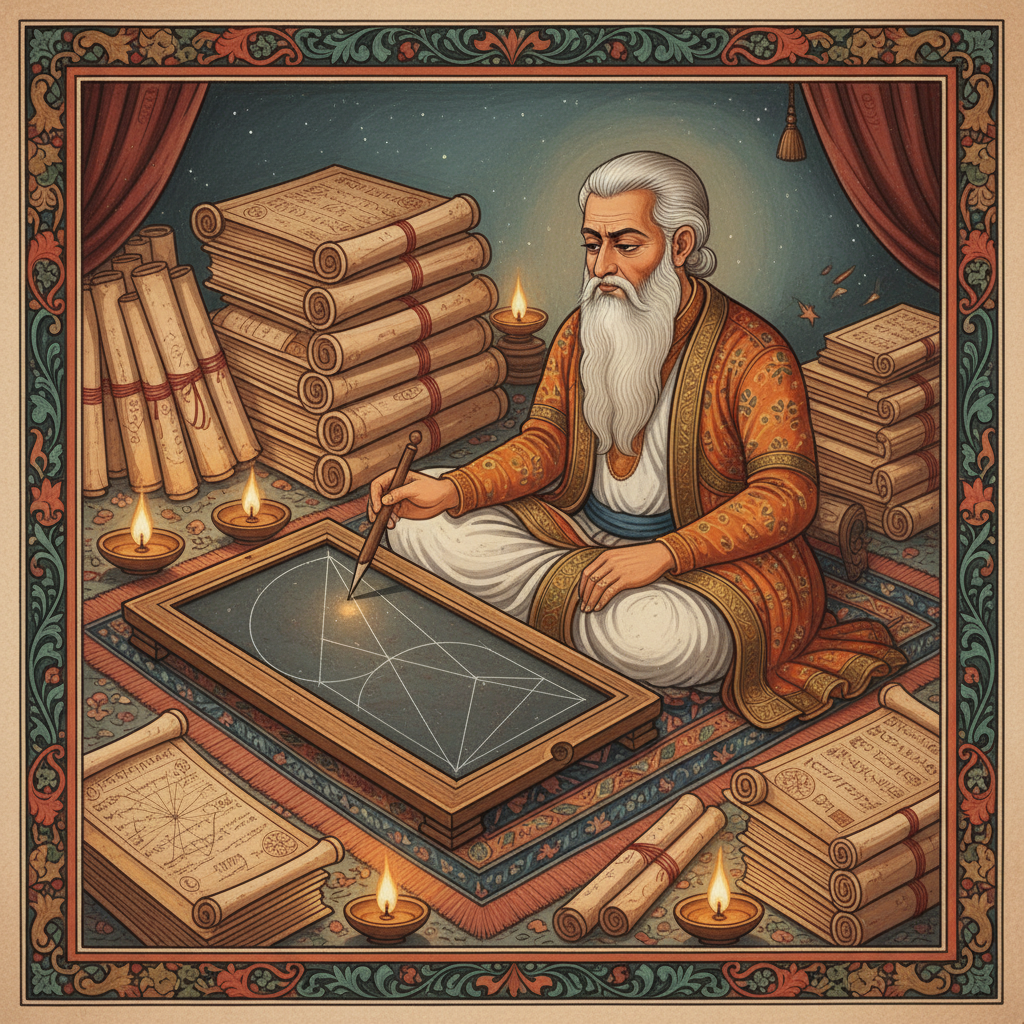
Research published in the Indian Journal of History of Science has identified a series of previously overlooked trigonometric short-cuts in the 11th-century Bhasvati, a handbook for astronomical calculations written by Shatananda. The mathematical analysis shows that the text utilizes a unique base-60 system and a simplified version of sine tables that allowed for rapid computation of planetary longitudes without the need for large-scale instruments.
The researchers found that the algorithms described in the Bhasvati are functionally equivalent to certain pre-calculus techniques used for approximation. By testing these methods against modern orbital models, the team discovered that the error margin was remarkably low, often less than one percent. This study underscores the practical ingenuity of medieval Indian mathematicians who focused on creating efficient, portable methods for timekeeping and calendrical construction for the general populace.