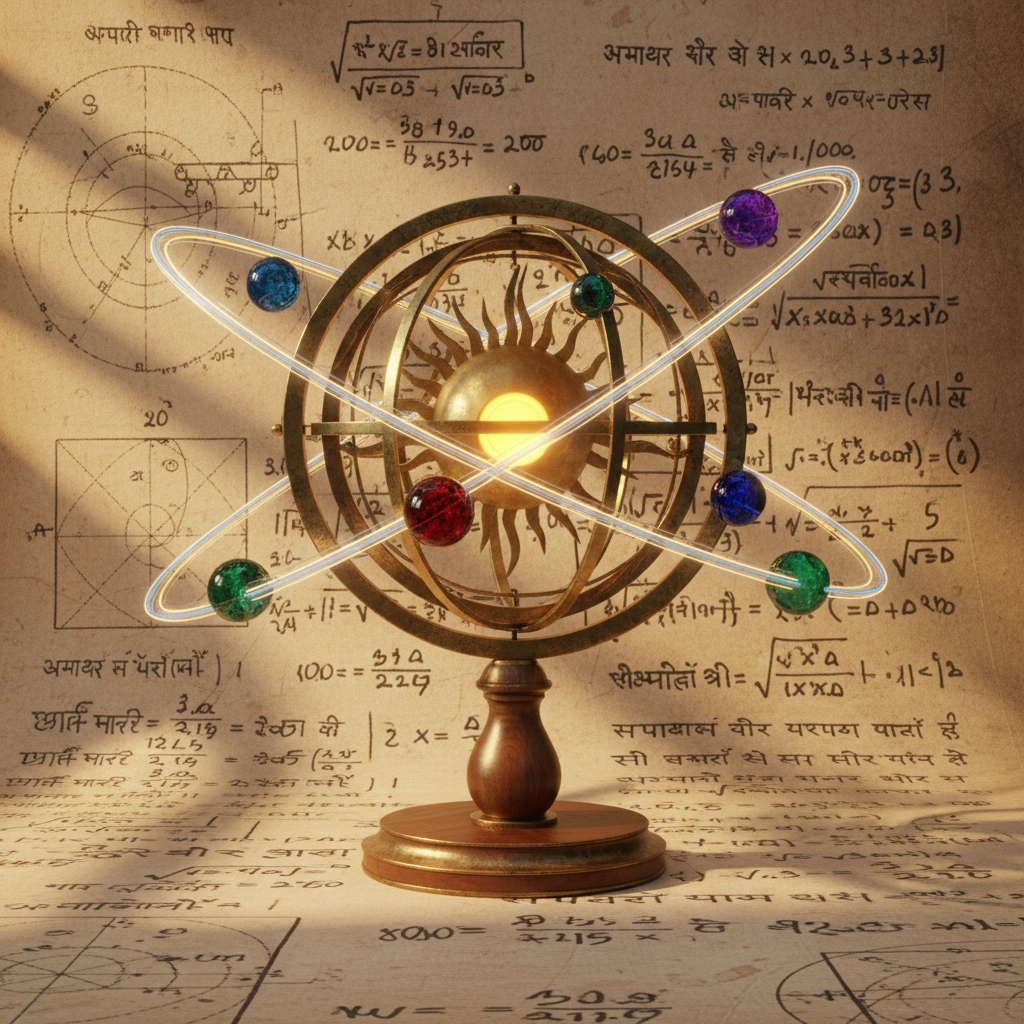
A new study published in Astronomy & Heritage has utilized advanced computational modeling to validate the mathematical precision of the Sisyadhivriddhida Tantra, a 7th-century astronomical treatise by the Indian mathematician Lalla. The research team simulated planetary movements over a 2,000-year period and compared them with Lalla’s sine-based algorithms for calculating the *Vakra-Gati* (retrograde motion) of Mars and Jupiter.
The results demonstrate that Lalla's models were accurate to within 0.05 degrees, a level of precision that suggests the existence of highly sophisticated observational instruments and trigonometric tables during the early medieval period in India. This research confirms that the 'Kerala School' of mathematics had roots in much earlier, geographically diverse traditions that had already mastered complex orbital mechanics centuries before the European Renaissance.