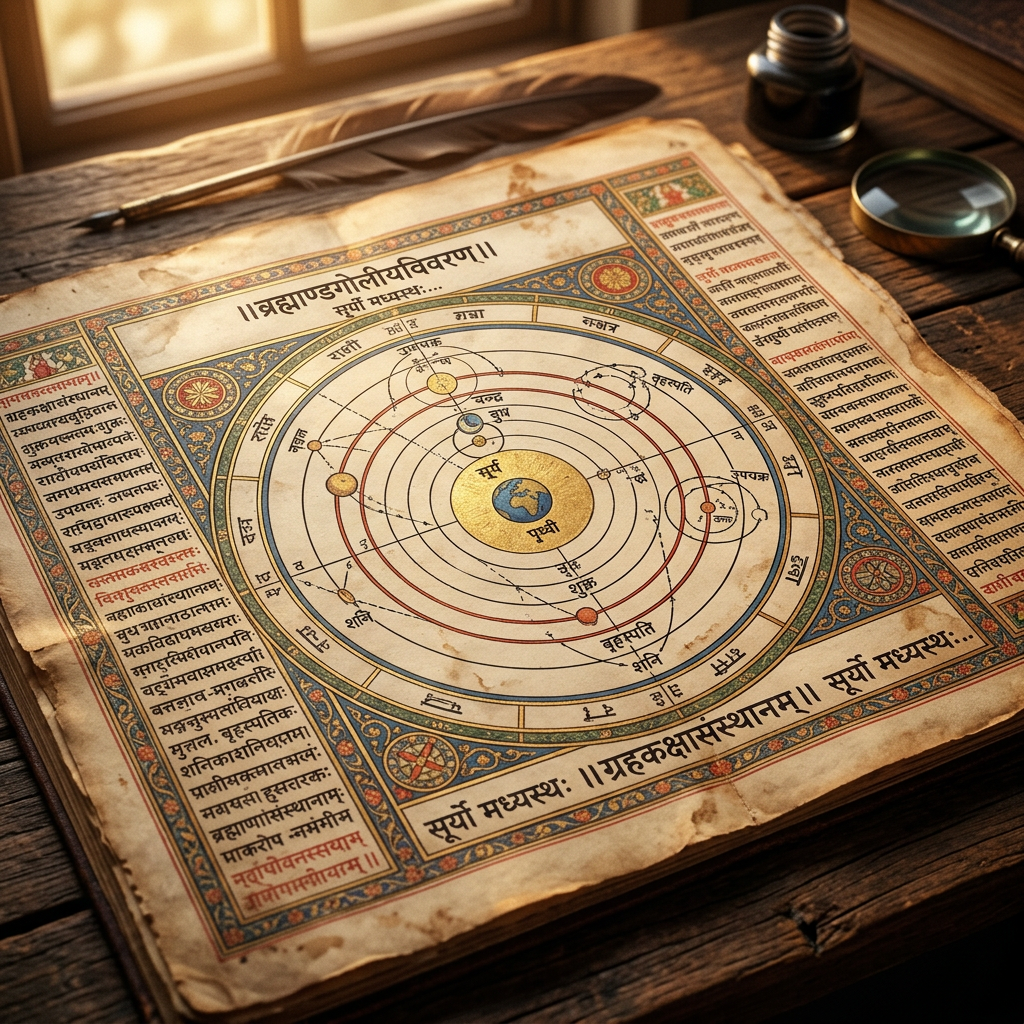
New research published in the Journal of Indian Philosophy and Science has unveiled sophisticated mathematical algorithms within 11th-century copies of Bhaskara II’s Siddhanta Siromani. By applying modern computational modeling to the Sanskrit verses, researchers found that ancient Indian astronomers used a form of iterative approximation to account for the orbital eccentricity of Mercury and Mars. These methods allowed for a level of predictive accuracy that was not matched in Western astronomy until the late Renaissance.
The study highlights how the 'Manda-Phala' (slow correction) calculations described in the manuscripts utilize a precursor to the sine-series expansion, specifically tailored to non-circular orbits. Scholars suggest that these mathematical tools were likely developed through centuries of meticulous observation at regional observatories. This breakthrough underscores the mathematical rigor of the medieval Indian astronomical tradition and its ability to solve complex non-linear problems through innovative Sanskrit poetic logic.