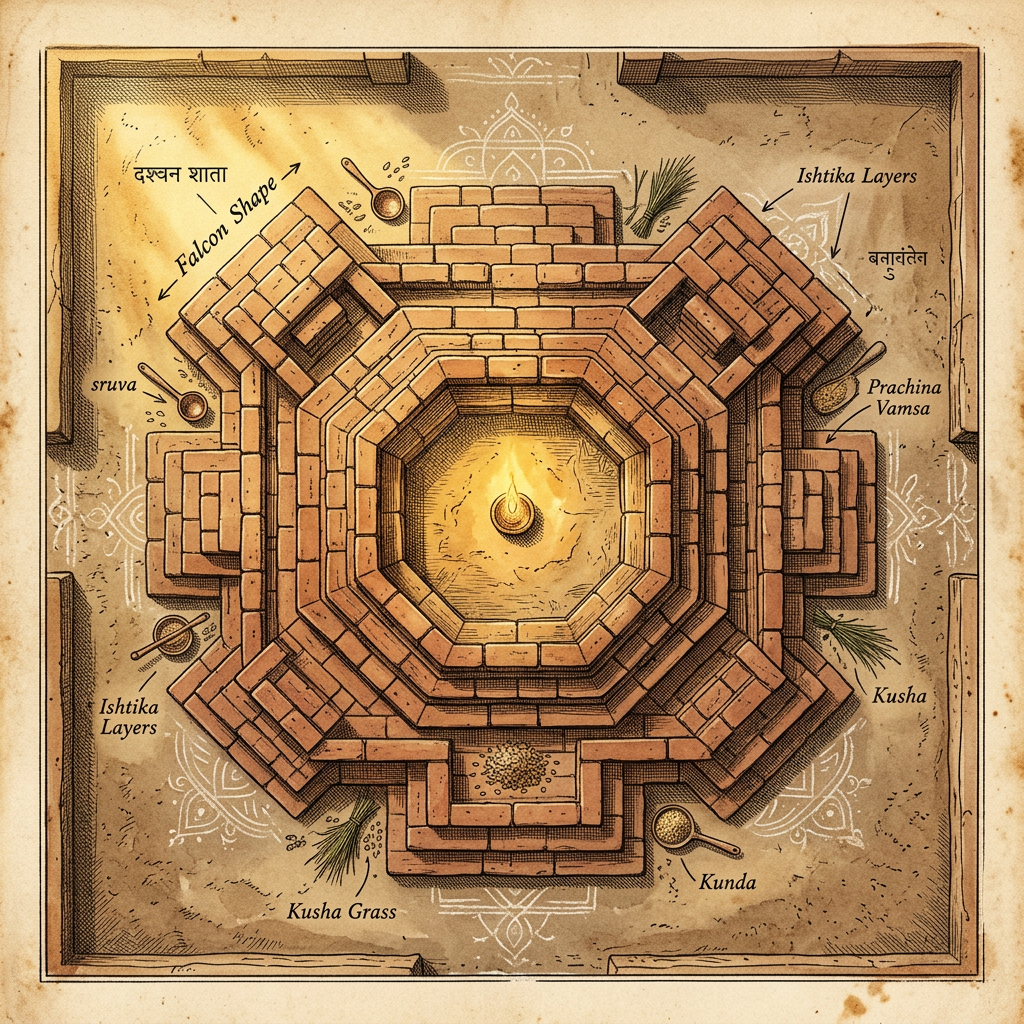
A new publication in the Annals of Mathematical History has provided a fresh analysis of the Baudhayana Sulba Sutra, dating back to approximately 800 BCE. The study identifies an unrecorded set of iterative geometric rules used for the construction of ritual altars with irregular polygonal boundaries. Unlike the standard 'squaring of the circle,' these rules utilize a series of recursive area-equivalence transformations to approximate the dimensions of complex, non-symmetrical shapes with startling precision.
The researchers utilized computer simulations to verify that the 'Agni-Chayana' altar designs described in the text follow a strict mathematical logic that accounts for the displacement of volume. This suggests that the Vedic mathematicians had conceptualized the principles of area summation and geometric series long before the formal development of these ideas in the Hellenistic world. The study concludes that the ritual requirements of Vedic sacrifice drove a unique and highly advanced form of constructive geometry in the early first millennium BCE.