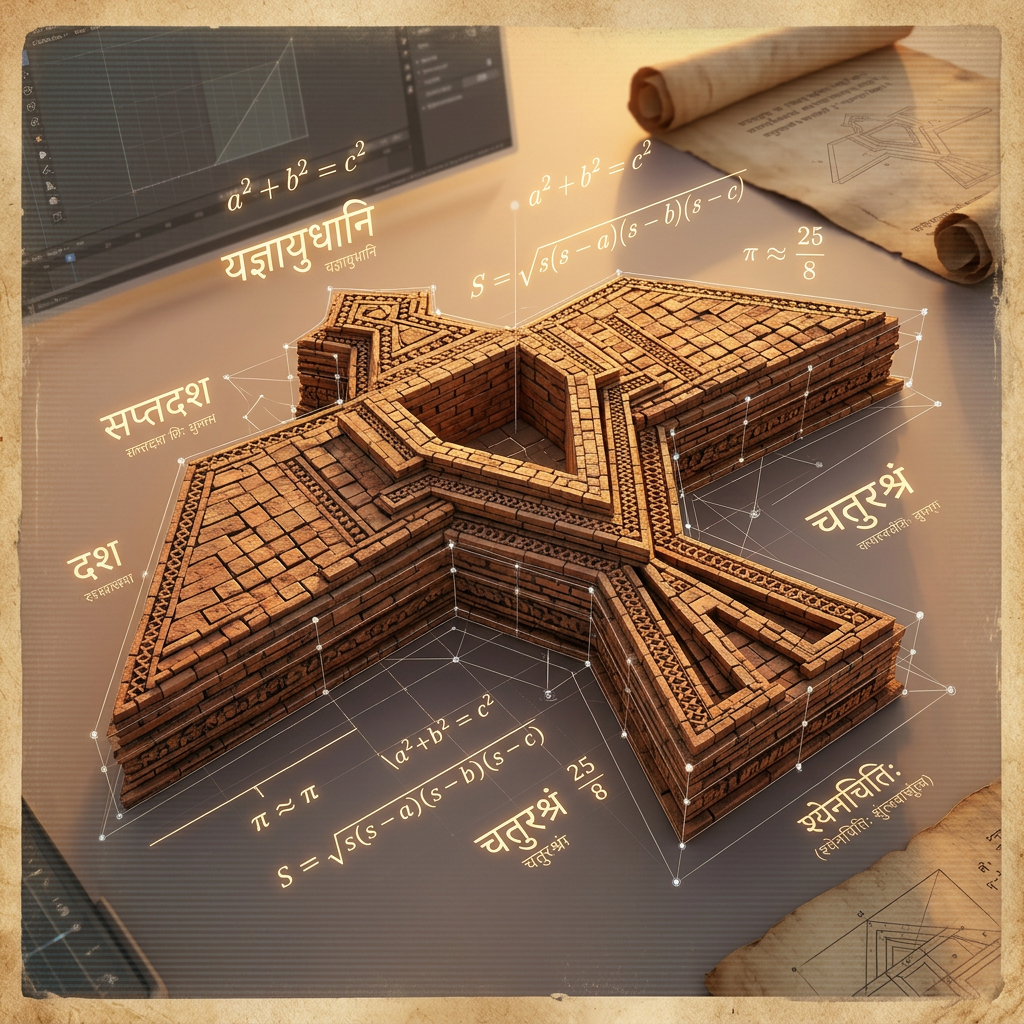
New research published in the Journal of Indian Mathematical Society has utilized advanced computational modeling to analyze the geometric instructions found in the Baudhayana Sulba Sutra. The study demonstrates that these ancient Sanskrit texts contain recursive algorithms for calculating trigonometric values—specifically sine and cosine equivalents—with a precision that reaches up to 12 decimal places. This level of mathematical sophistication predates similar European developments by over a millennium.
The scholars argue that these algorithms were not merely used for ritual altar construction but represented a deep theoretical understanding of circular geometry and irrational numbers. By simulating the construction techniques described in the text, the researchers were able to prove that the 'Vedic' mathematicians had a formalized system for error correction in large-scale geometric layouts, ensuring structural integrity for complex architectural projects.