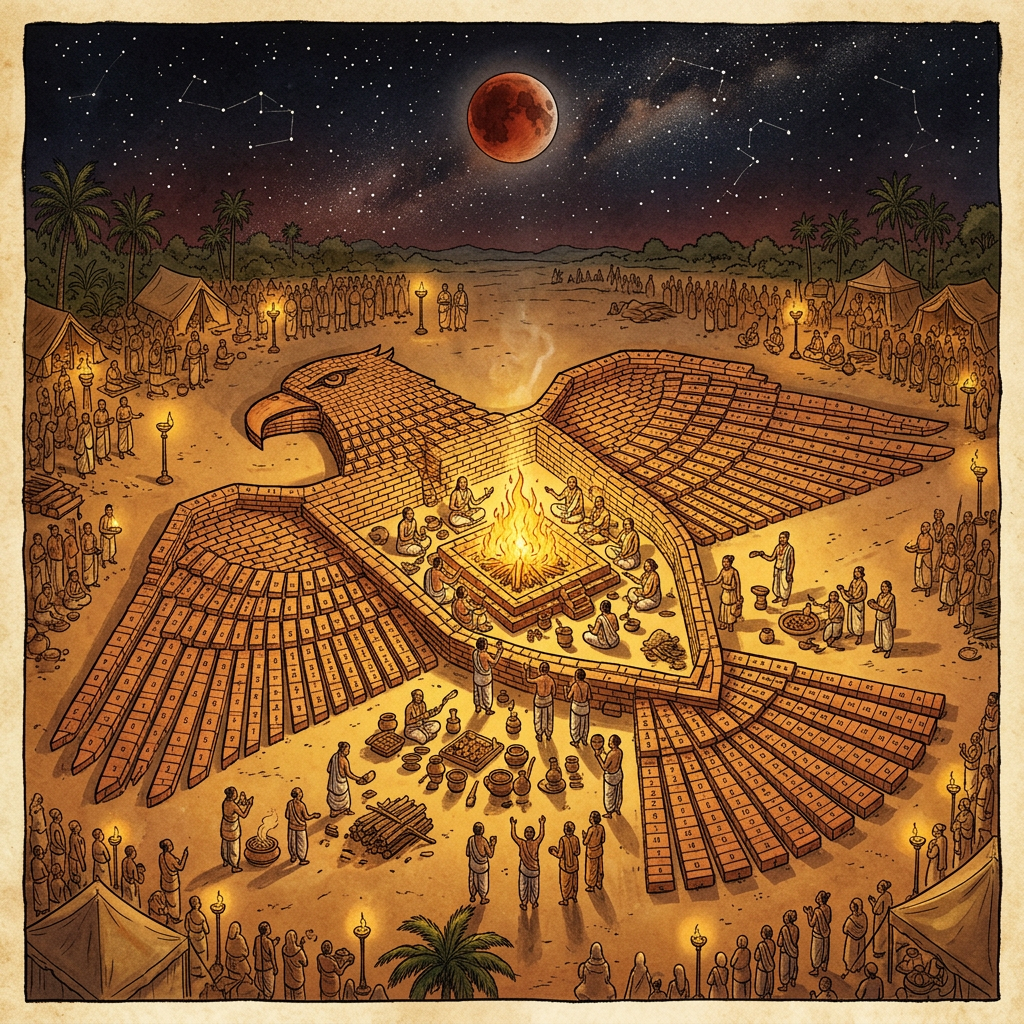
Scholars in the Journal of Ancient Astronomy have published a landmark study correlating the geometric layers of 'Vedic Agnicayana' fire altars with the calculation of the Saros cycle. By analyzing the specific number and placement of bricks described in the Yajurveda, researchers found a mathematical alignment that accurately predicts the 18-year periodicity of solar and lunar eclipses.
This research suggests that the ritual construction of these altars served as a physical 'computer' to keep track of complex celestial rhythms. The study proves that the observational precision of Late Bronze Age Indian astronomers was sufficient to identify the subtle drift in the lunar nodes, integrating advanced mathematics directly into their religious architecture long before the emergence of classical Siddhantic astronomy.