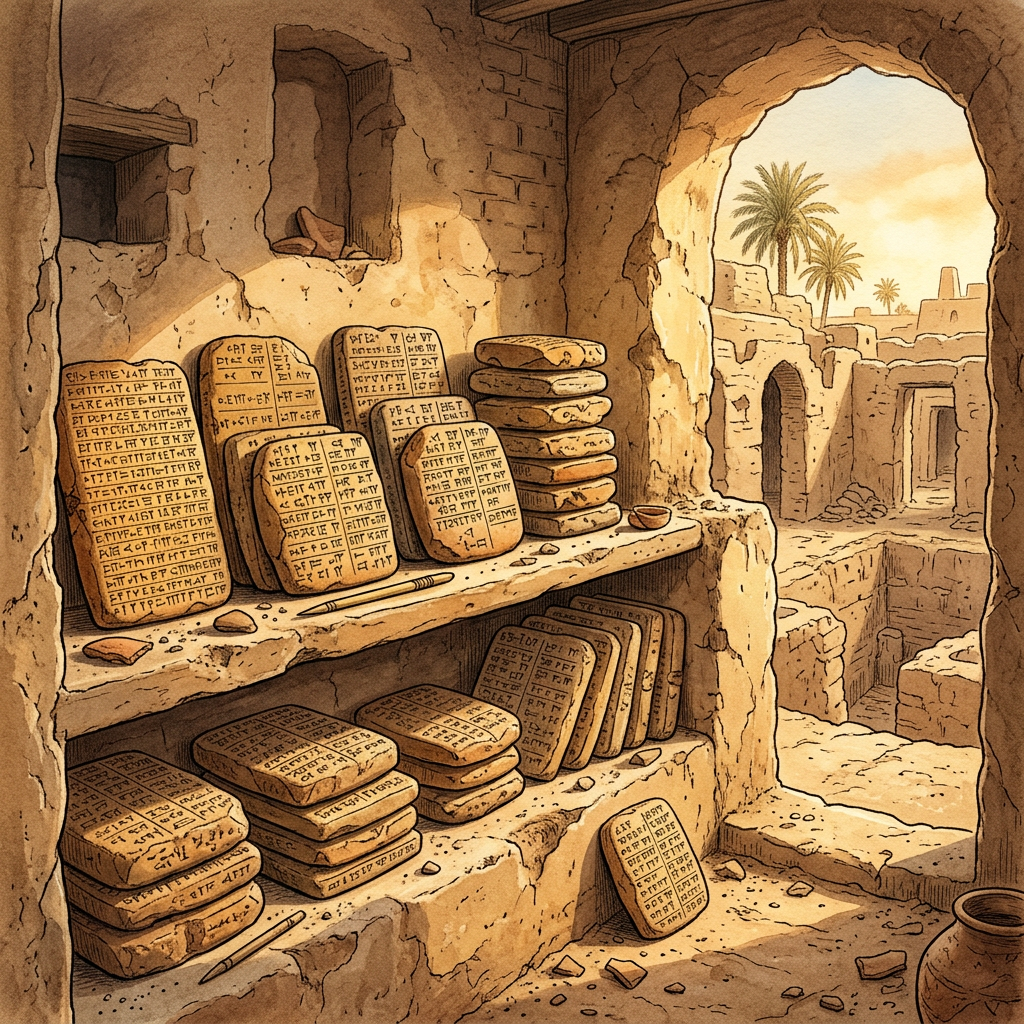
In the ruins of the ancient Sumerian city of Larsa, archaeologists have excavated a structure they believe served as a school for advanced mathematical research. The team recovered hundreds of cuneiform tablets containing complex algebraic equations, including calculations for quadratic functions and sophisticated geometric proofs. These findings suggest that Babylonian mathematics was far more theoretical and advanced than previously assumed by modern historians.
One set of tablets appears to be a curriculum for senior scribes, featuring difficult problems related to compound interest and the calculation of orbital movements. The discovery of these instructional materials within a dedicated educational wing provides a new understanding of how mathematical knowledge was formalized and transmitted in ancient Mesopotamia. The archive is currently being digitized to assist researchers in deciphering the full extent of Babylonian algebraic theory.