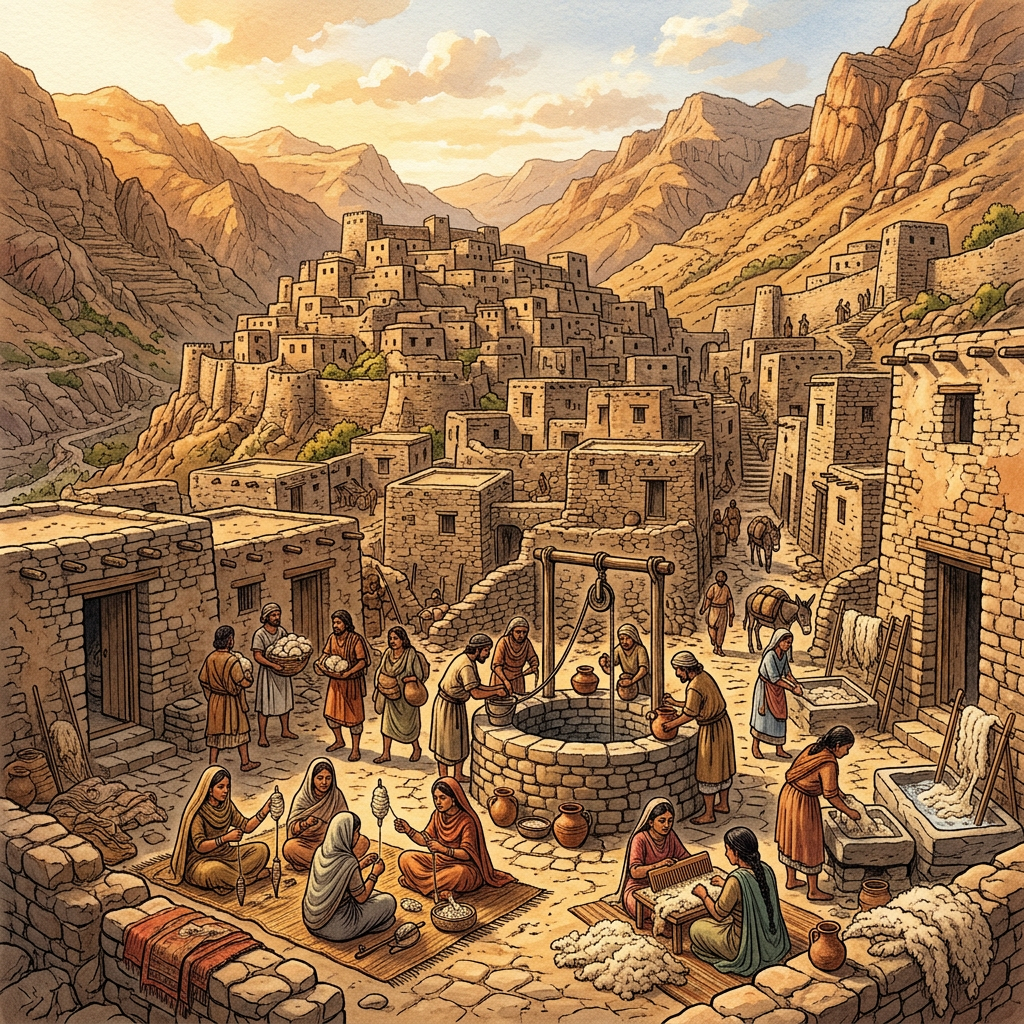
Archaeologists have identified a new Indus Valley Civilization outpost situated at an altitude of over 2,000 meters in the Bolan Pass of modern-day Pakistan. This settlement, dating to the Mature Harappan phase (2500–1900 BCE), features the characteristic grid-based urban planning and standardized brickwork of the lowlands but is uniquely adapted to a mountain environment with stone-reinforced foundations to prevent landslides.
The most significant find at the site is a large cache of fine-wool textile fragments and specialized bone combs used for cleaning animal fibers. Isotopic analysis of goat and sheep remains suggests that the settlement served as a critical collection and processing hub for high-quality wool from the Central Asian highlands, which was then transported to the metropolitan centers of Mohenjo-daro and Harappa. This confirms the existence of a robust, organized high-altitude economic sector within the Indus empire.