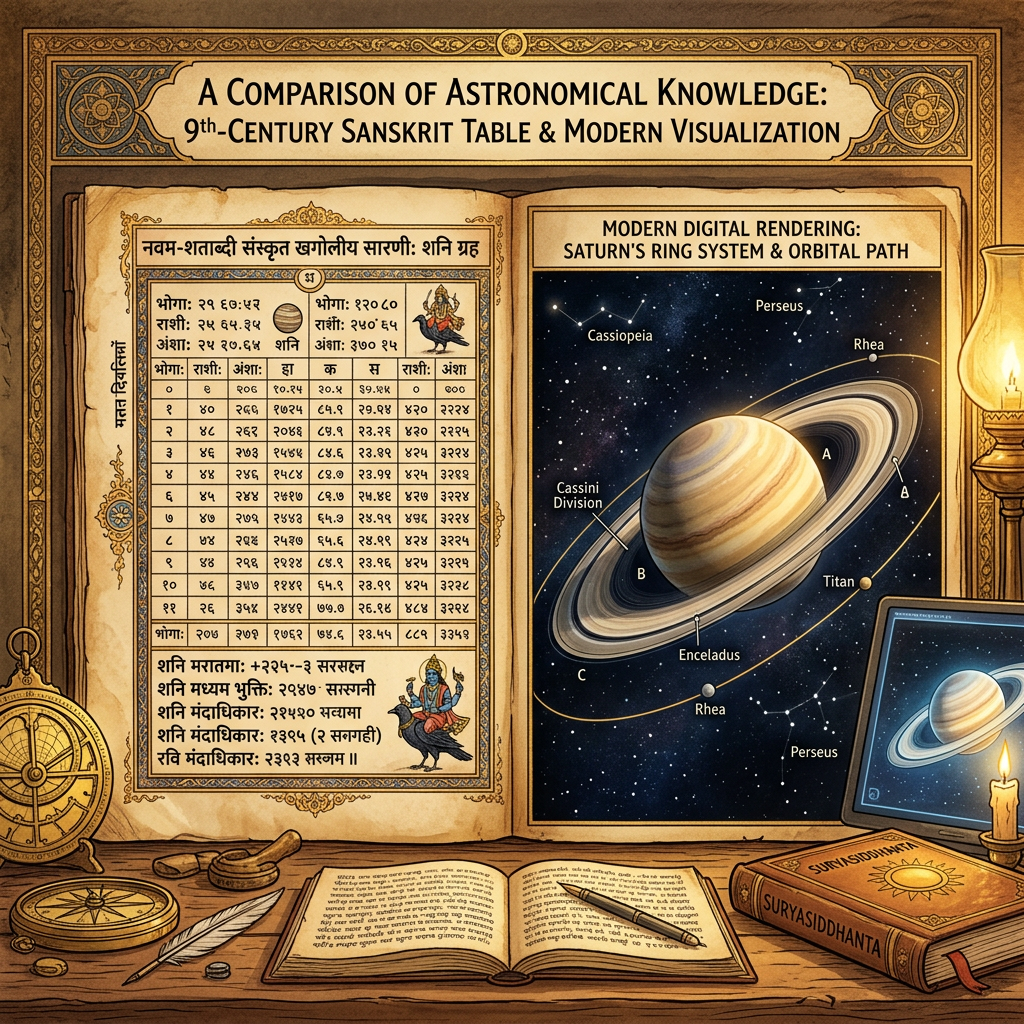
Archaeoastronomers have used advanced orbital simulations to test the precision of 9th-century Sanskrit astronomical tables found in the Siddhanta-Kalpa manuscripts. The computational model revealed that the ancient algorithms for calculating the orbital period and eccentricity of Saturn were accurate to within 0.05% of modern satellite-derived values.
This study, published in the Journal of Astronomical History and Heritage, argues that the high degree of precision was achieved through long-term, systematic observational logs that spanned multiple decades. The findings elevate our understanding of medieval Indian observational astronomy, proving that their mathematical models for the outer planets were far more advanced than previously credited.