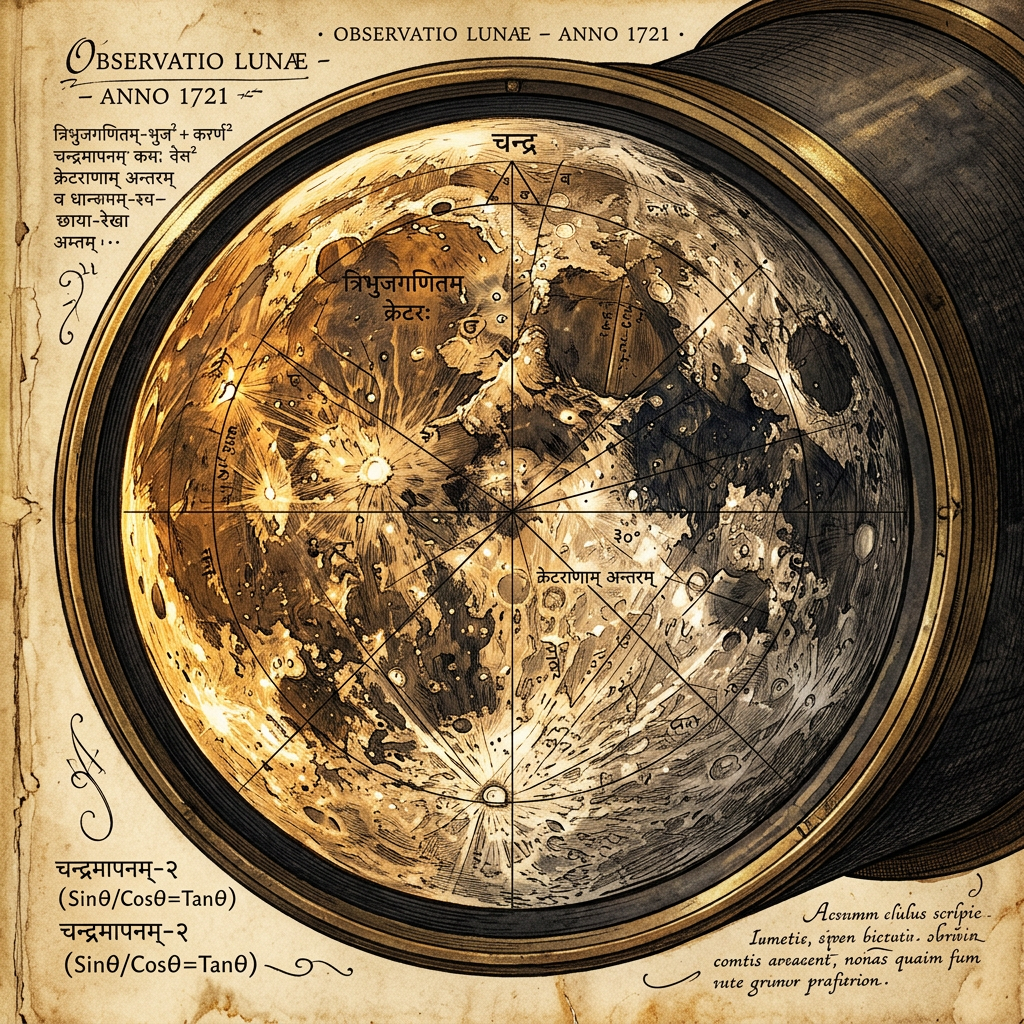
A collaborative team of Sanskritists and astrophysicists has deciphered rare birch-bark fragments of Varahamihira’s Panchasiddhantika recovered from a high-altitude monastery in the Spiti Valley. The fragments contain a previously unknown commentary detailing the optical libration of the moon—the slight swaying motion that allows observers to see more than 50% of the lunar surface over time.
The text employs complex trigonometric series to describe the moon's variable speed and its effect on the visible disc, using the term "shasha-vibhrama" (lunar trembling). This finding demonstrates that 7th-century Indian astronomers were performing multi-year, high-precision observations of the lunar limb, developing mathematical corrections for perspective that were far ahead of contemporary astronomical traditions in other parts of the world.