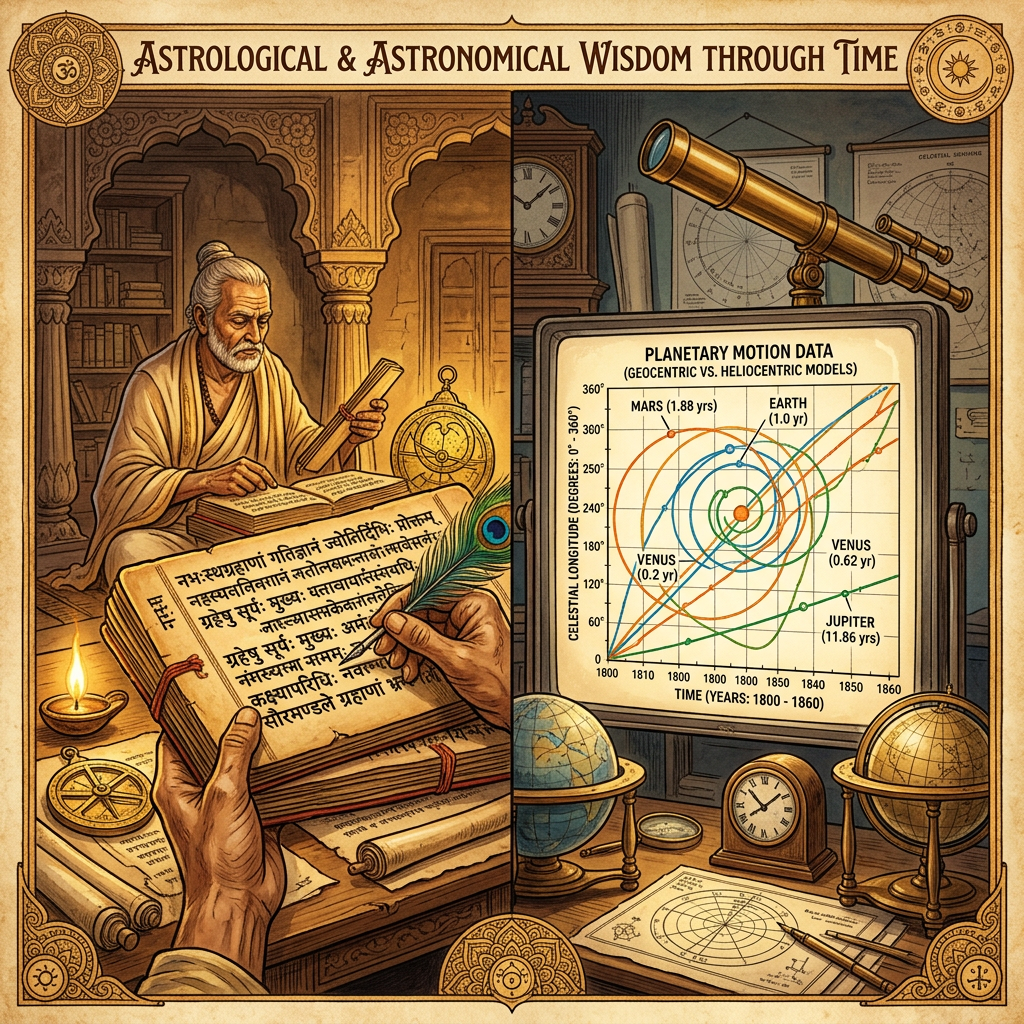
A new research paper in Current Science explores the mathematical logic within the 10th-century Vakya-Karana manuscripts. Using computational modeling, researchers found that the Sanskrit texts employed a sophisticated form of discrete-time series analysis to predict planetary occultations with an error margin of less than one arc-minute over a century.
The study highlights how ancient Indian astronomers used mnemonic verses (vakyas) to store complex numerical data, allowing for rapid calculations without the need for large geometric models. This research re-validates the efficiency of the Katapayadi system in translating astronomical constants into poetic meter for long-term data preservation.