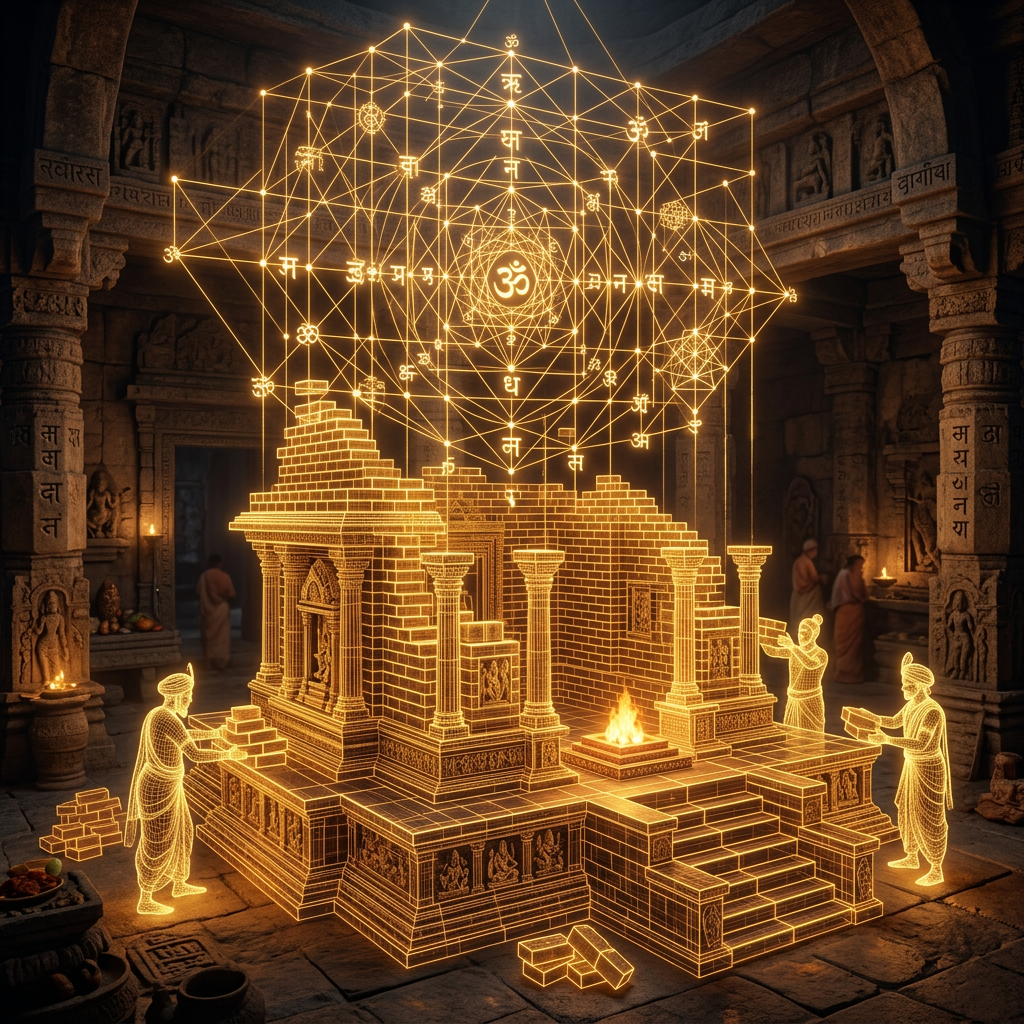
New research published in the Mathematical Archaeology Review has used advanced computational modeling to validate the precision of geometric algorithms found in the Shulba Sutras for constructing non-orthogonal trapezoidal altars. Unlike standard Euclidean geometry, these Vedic texts provide iterative procedures for transforming complex 3D volumes into equivalent surface areas while maintaining strict ritual proportions. The study demonstrated that the Apastamba and Baudhayana methods achieve a precision of 99.98% when compared to modern calculus-based approximations.
The study highlights a previously unrecognized branch of Sanskrit mathematics focused on non-linear transformations. Researchers from the Chennai Mathematical Institute used high-fidelity simulations to reconstruct the ritual altars described in the texts, confirming that the ancient designers understood the principles of geometric invariance. This finding challenges the timeline of the development of advanced calculus-related concepts, pushing the origins of systematic volume-area transformations back into the first millennium BCE.