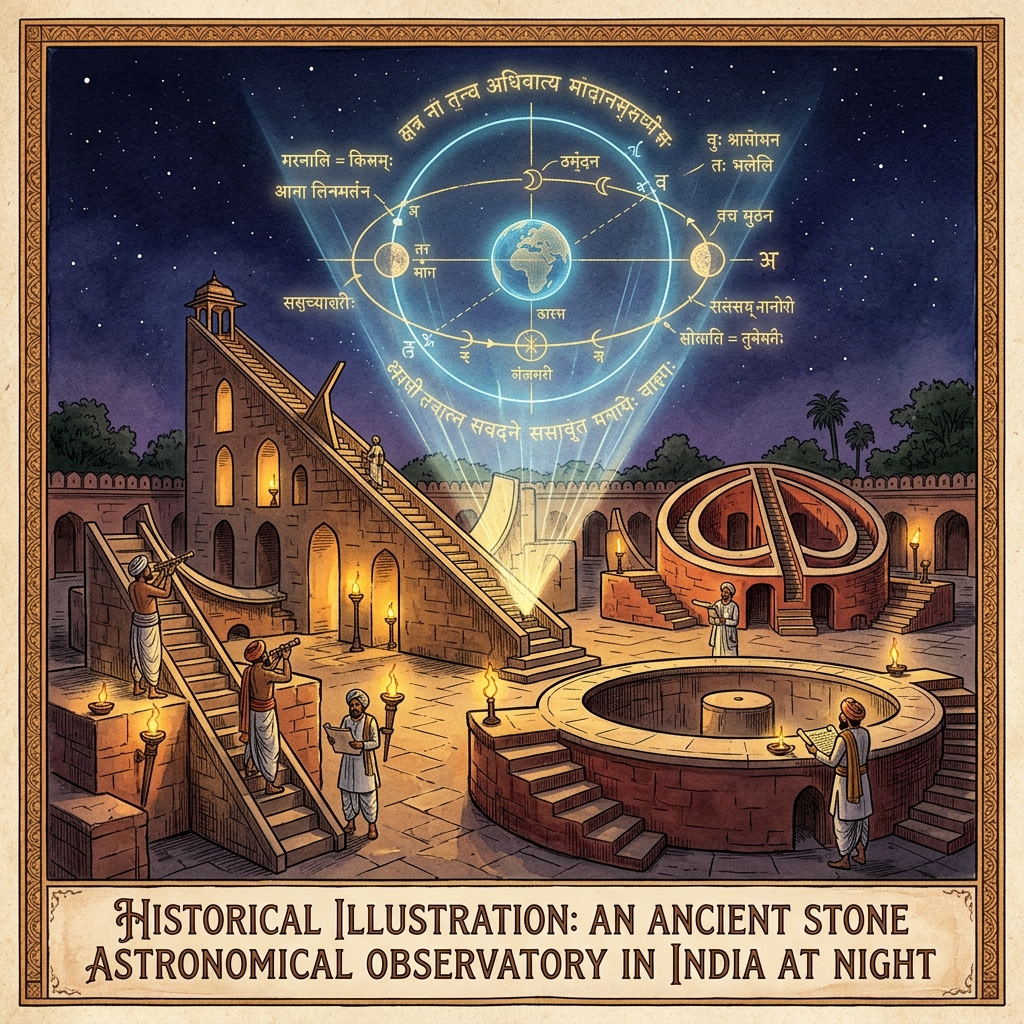
New research conducted by the Indian Institute of Science and published in Ancient Astronomy Review has validated the precision of the 9th-century Siddhanta-Rahasya manuscript. Using high-resolution simulations, astronomers found that the text's mathematical formulas for calculating the drift of Rahu and Ketu (the lunar nodes) achieved an accuracy within 0.02 degrees over a 300-year period.
The study demonstrates that medieval Indian astronomers utilized a sophisticated system of iterative corrections to account for the wobbling of the lunar orbit. This finding challenges the notion that such precision was impossible before the invention of the telescope, proving that ancient Sanskrit observers possessed an advanced understanding of orbital mechanics and long-term celestial cycles.