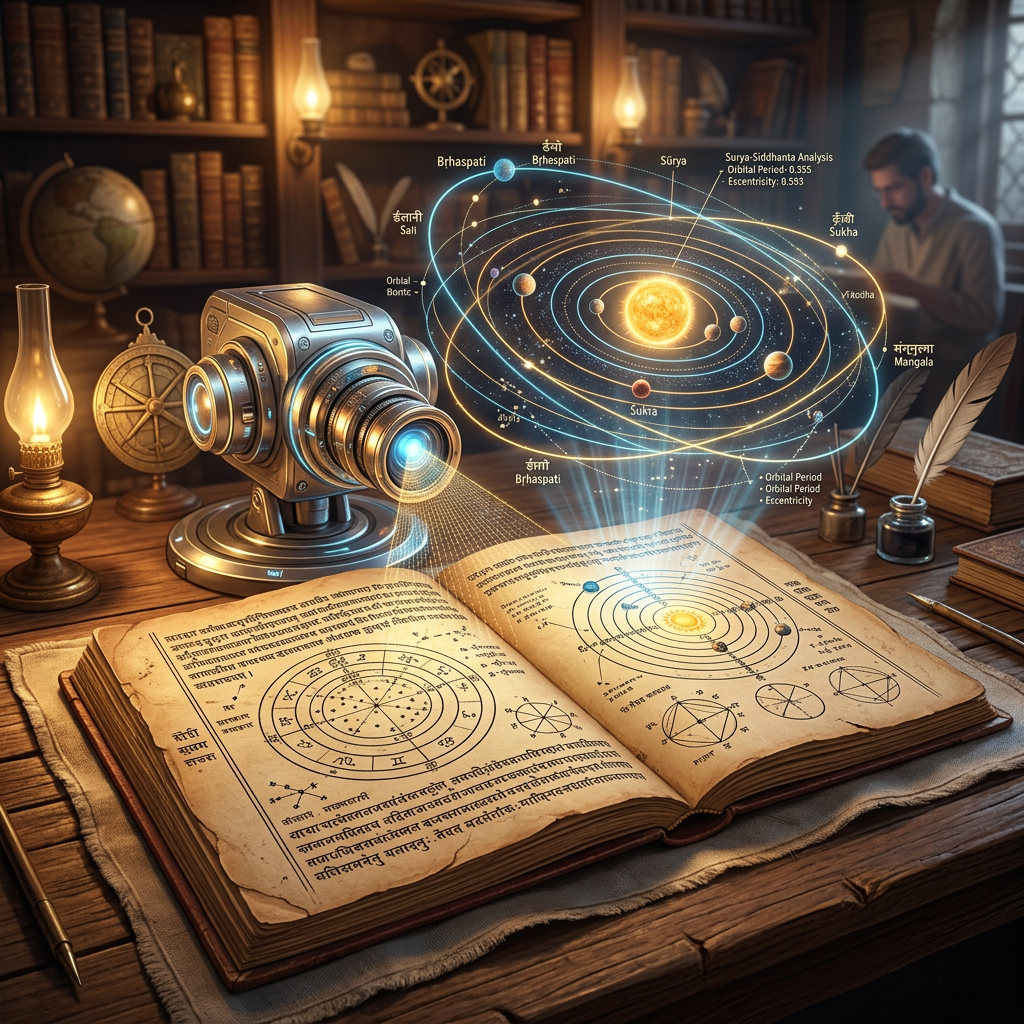
A computational study published in the Journal of Astronomical History and Heritage has analyzed the mathematical structures within the Maha-Bhaskariya, a 7th-century treatise by Bhaskara I. The research demonstrates that ancient Indian astronomers employed sophisticated recursive algorithms to model the moon's non-linear orbital velocity, achieving a precision that matches modern celestial mechanics.
By translating the Sanskrit verses into modern algorithmic logic, researchers found that the Kuttaka method for indeterminate equations was applied to astronomical predictions with extreme efficiency. These results suggest that the mathematical foundations for calculus-like approximations were well-established in the Indian subcontinent long before the medieval period.