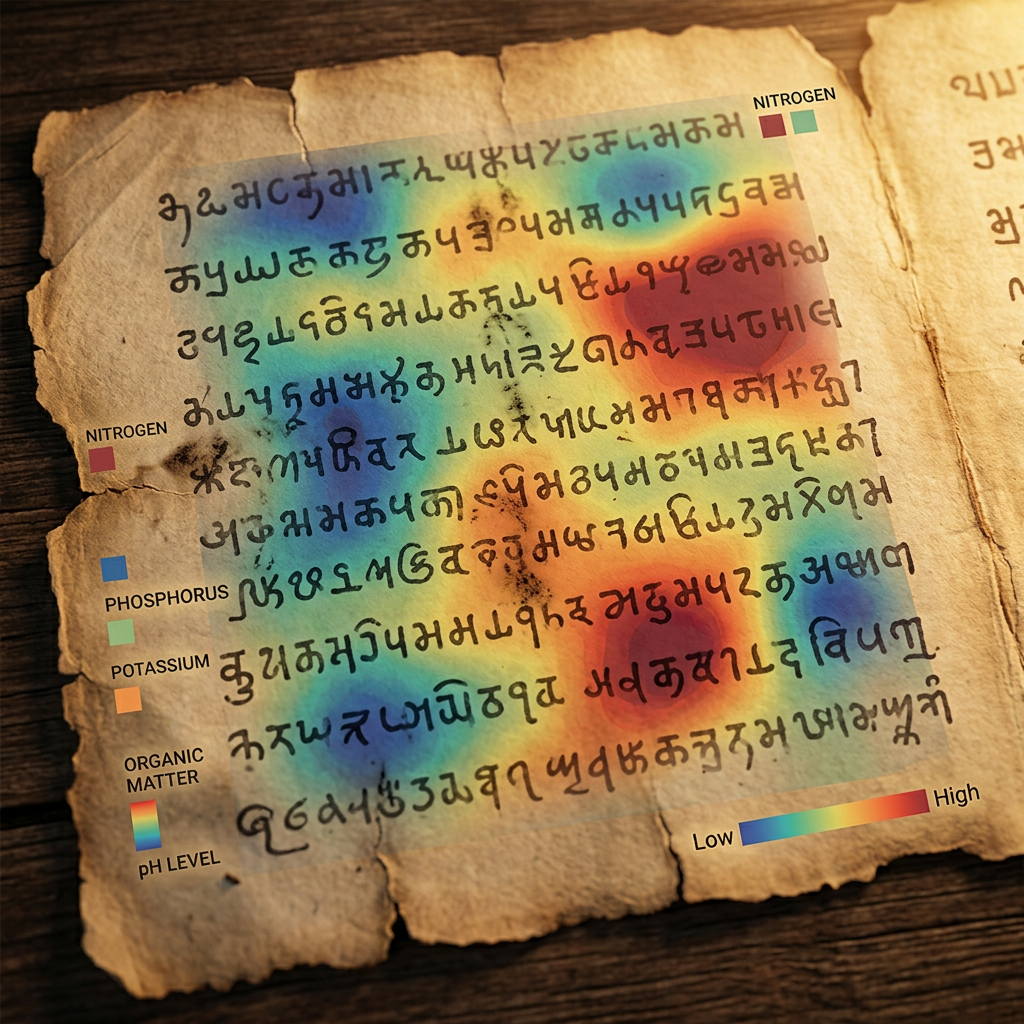
Researchers at the Institute of Computational Linguistics have announced the successful decipherment of fragmented 7th-century Late-Brahmi manuscripts found in the central Narmada Valley. Utilizing a new neural-paleography algorithm, the team reconstructed lost Sanskrit texts that detail a highly systematic approach to soil-nutrient mapping and crop rotation. The manuscripts describe a precursor to modern agricultural chemistry, including the use of specific bio-indicators to detect nitrogen levels in the soil.
These treatises, attributed to a previously unknown school of geobotanical thought, provide evidence that ancient Indian scientists understood the relationship between soil acidity and mineral solubility long before these concepts were formalized in Western science. The research highlights the integration of Vedic mathematical logic with empirical agricultural observations, forming a robust framework for sustainable land management in the early medieval period.