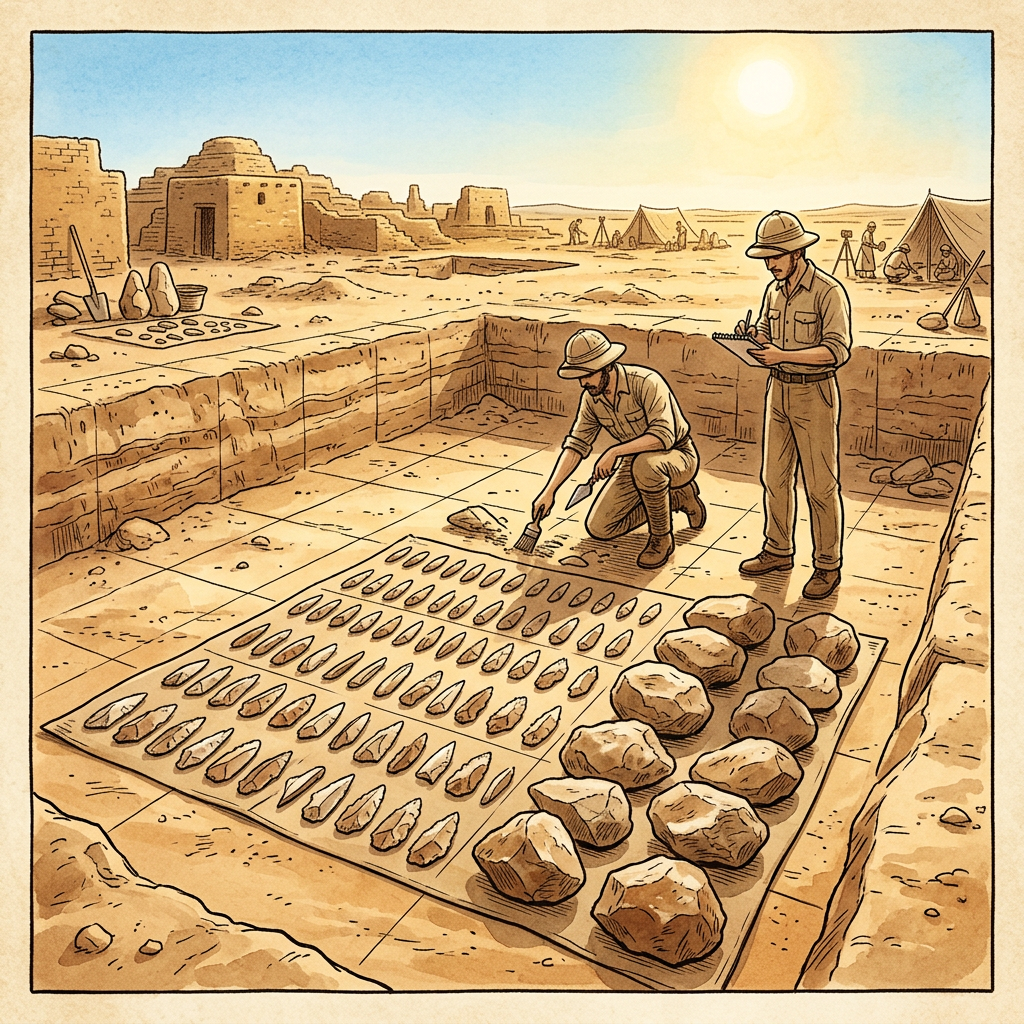
A joint international mission has discovered a massive stone-tool manufacturing complex at a newly identified Indus Valley site in the Rohri Hills region of Sindh. The workshop dates back to the Mature Harappan period and is specialized in the production of precision chert blades, which were ubiquitous across the civilization for both domestic and industrial use. The site contains tens of thousands of lithic flakes, core stones, and finished blades in various stages of refinement.
Unlike other urban centers where tools were often imported, this site appears to have been a dedicated industrial outpost located directly at the source of high-quality raw material. Archaeologists found evidence of standardized production techniques, with blades sorted by length and thickness, suggesting a highly regulated manufacturing process intended for export to major cities like Mohenjo-Daro and Harappa.
The discovery also included specialized copper-tipped bone pressure-flakers used to achieve the razor-sharp edges characteristic of Indus lithics. The presence of these tools, alongside unfinished stone seals, suggests that the site was not merely a quarry but a sophisticated center for artisan training and technological innovation in the 3rd millennium BCE.