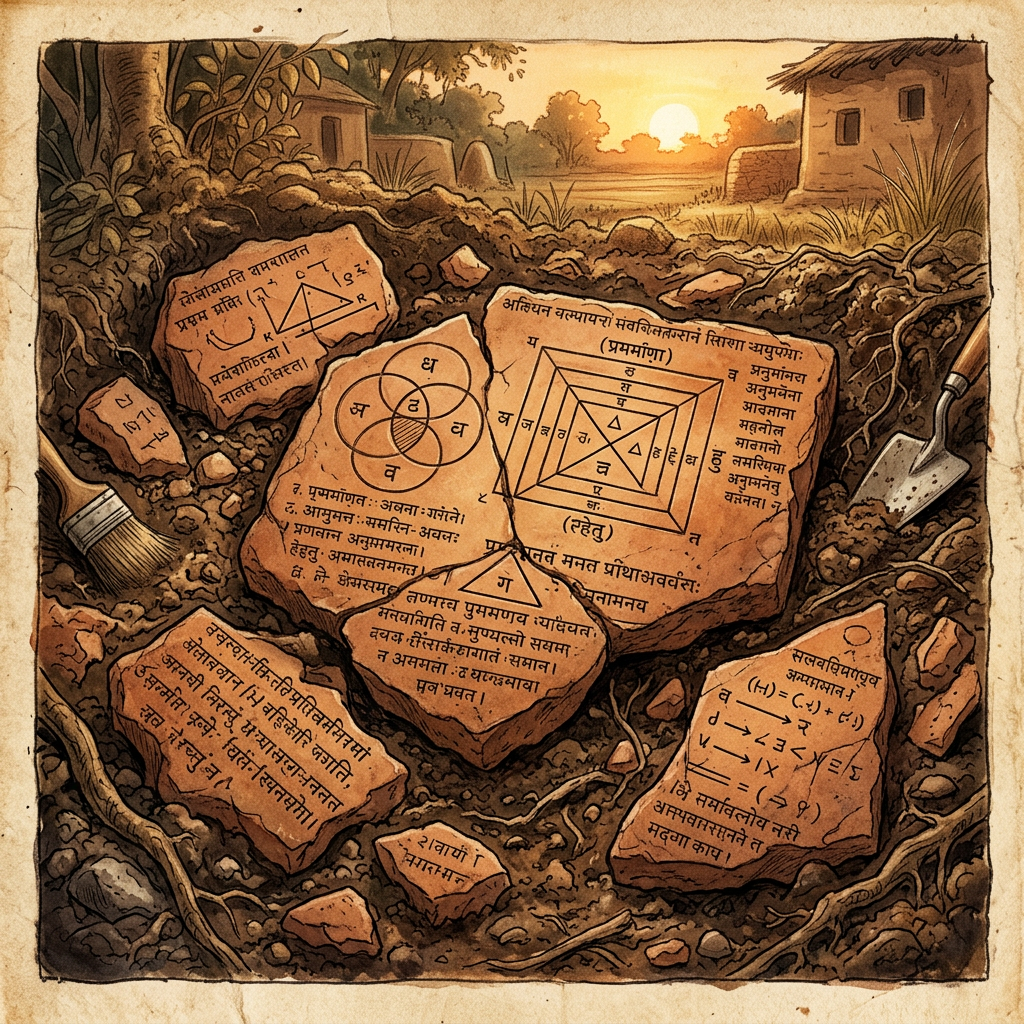
Excavations at a historical site in Mithila, Bihar, have unearthed terracotta fragments of a lost logic manual known as the 'Yukti-Manjari'. Dated to the early 11th century, the fragments contain complex syllogisms that challenge the standard Nyaya (logic) school's view on the perception of absence. The text introduces a unique logical category called 'Aniruddha-Yukti', or non-obstructed reasoning, used to prove the existence of unseen ethical causes.
The discovery is being hailed as a major breakthrough for the history of Indian epistemology. Experts suggest that the Yukti-Manjari represents a 'lost school' of Mithila logic that flourished briefly before the rise of Navya-Nyaya. The fragments include diagrams and flowcharts of arguments, indicating a highly visual method of teaching ancient logic.