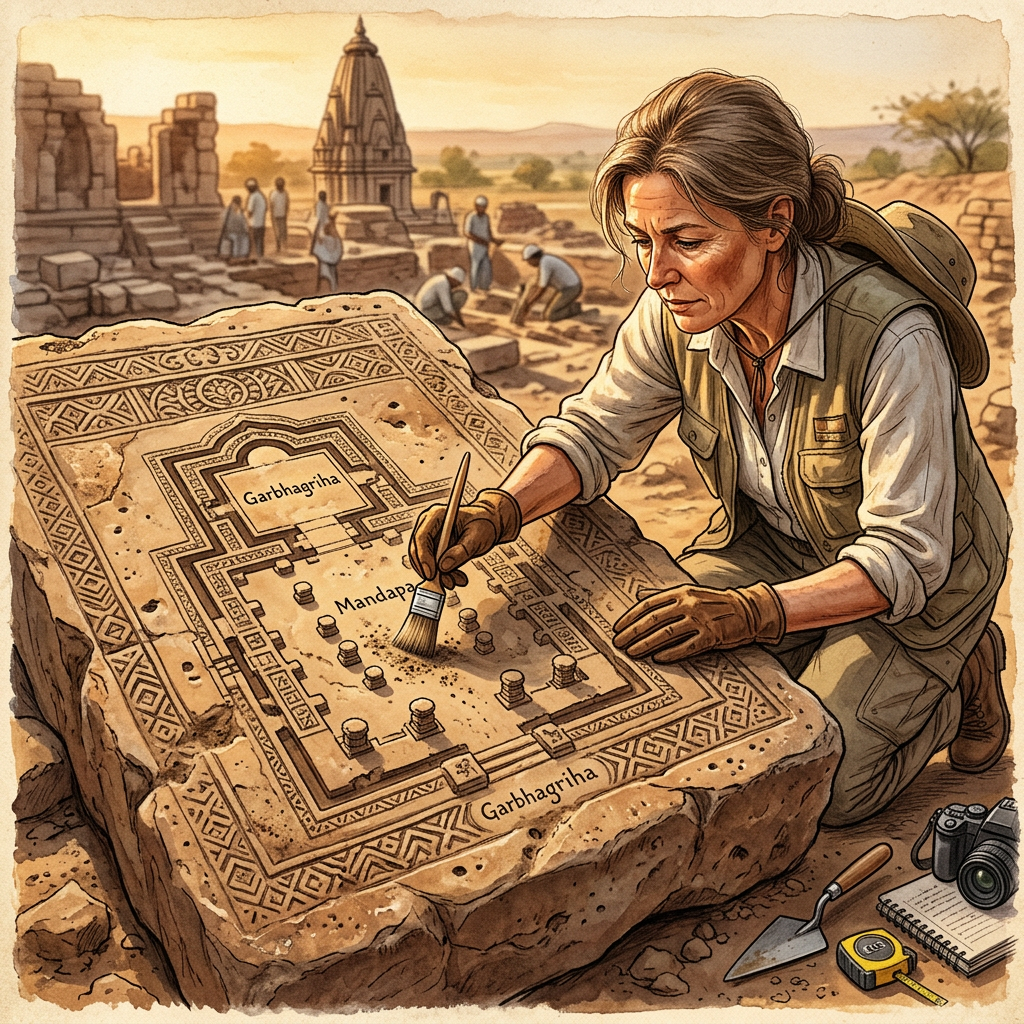
During the structural restoration of a dilapidated 9th-century Shiva temple in Rajasthan’s Pali district, conservationists have discovered rare architectural blueprints etched directly into the stone foundation slabs. These carvings, known as rekha-vinyasa, provide a literal map of the temple’s original Nagara-style proportions and the geometric grid used for the placement of the shikhara. This discovery is a breakthrough for scholars studying the mathematical precision of early medieval Indian architecture.
The restoration project, led by a team of heritage architects, aims to use these original engravings to guide the reassembly of fallen stone blocks. By following the 1,100-year-old plans, the team hopes to restore the temple to its exact original silhouette. This find underscores the advanced engineering knowledge of the Gurjara-Pratihara builders, who integrated religious iconography with rigorous geometric principles.