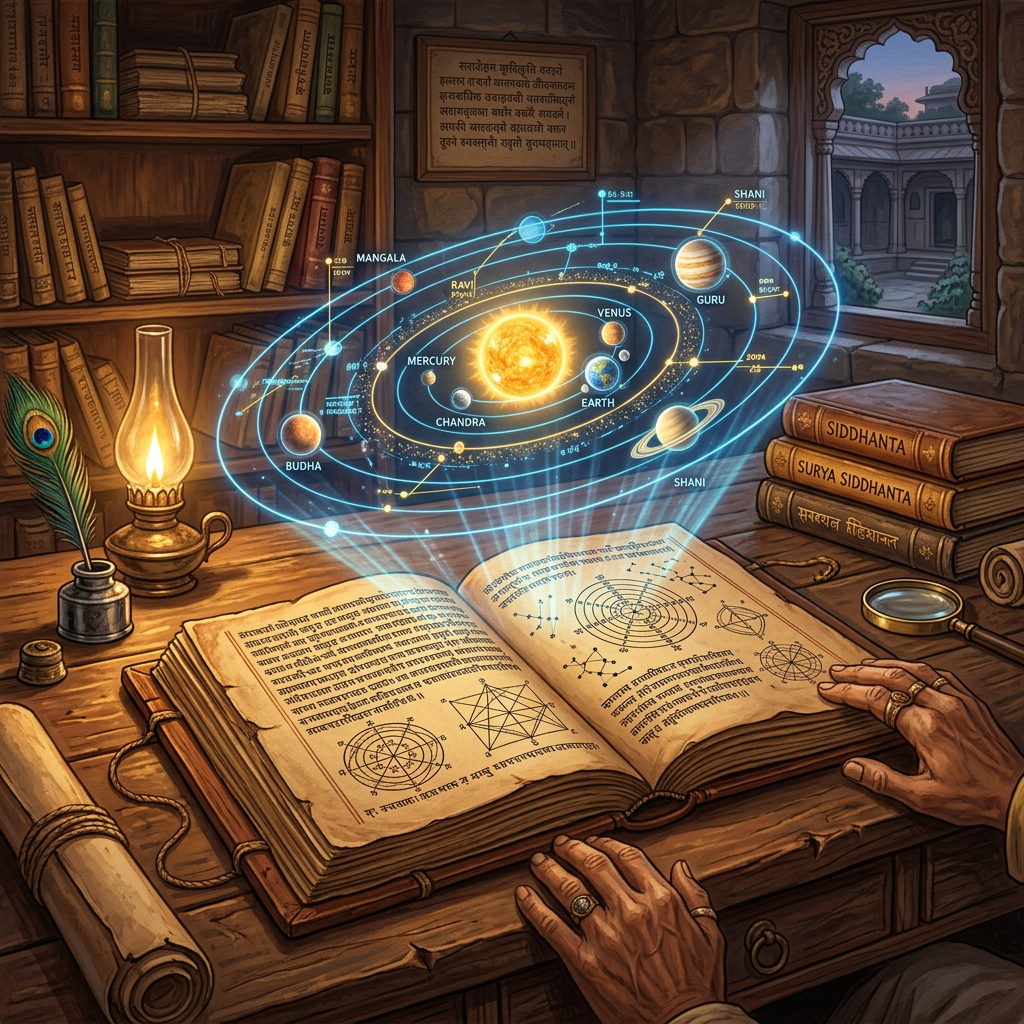
A breakthrough study published in the Journal of Ethno-Mathematics has analyzed several 11th-century Sanskrit manuscripts of the Karana-Kutuhala, a celebrated astronomical treatise by Bhaskara II. Using modern computational modeling, researchers from the Indian Institute of Science have demonstrated that the text contains sophisticated recursive algorithms designed to calculate the instantaneous velocities of planets. These mathematical methods appear to predate similar developments in European kinematics by several centuries, showcasing a high degree of precision in modeling non-linear motion within the geocentric framework.
The study highlights how ancient Indian astronomers utilized a unique system of sine-table interpolations and infinitesimal-like logic to refine planetary positions. By reconstructing these algorithms in a digital environment, the team verified that the results align with modern orbital dynamics for the periods described, suggesting that the observational data supporting the text was far more rigorous than previously assumed. This research provides a new lens into the algorithmic complexity of the medieval Kerala and Ujjain schools of mathematics.