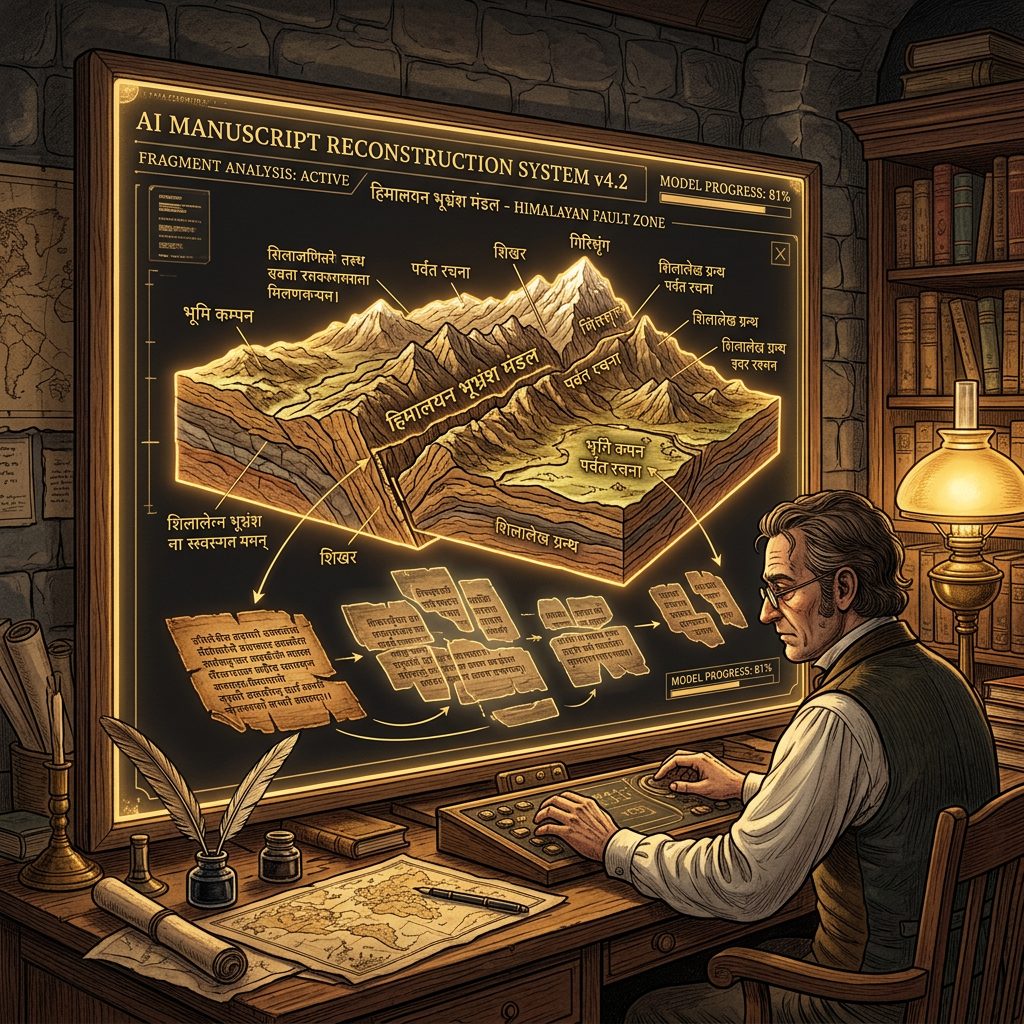
A research team specializing in Digital Humanities has successfully used a custom neural network to decipher fragmented birch-bark manuscripts in the Sharada script found in a high-altitude Kashmiri cave. The texts, dated to approximately 850 CE, contain lost Sanskrit treatises on the measurement of tectonic displacement. The authors used solar shadow calibration and precise water-level markers to track the gradual uplift and shifting of the Himalayan foothills.
The AI-driven reconstruction reveals that medieval Indian scholars were monitoring seismic changes with a degree of systematic observation previously thought impossible for that era. These treatises describe methods for predicting potential landslides and changes in river courses based on these slow tectonic movements. This discovery provides new insights into the ancient Indian scientific tradition's focus on terrestrial mechanics and environmental resilience.