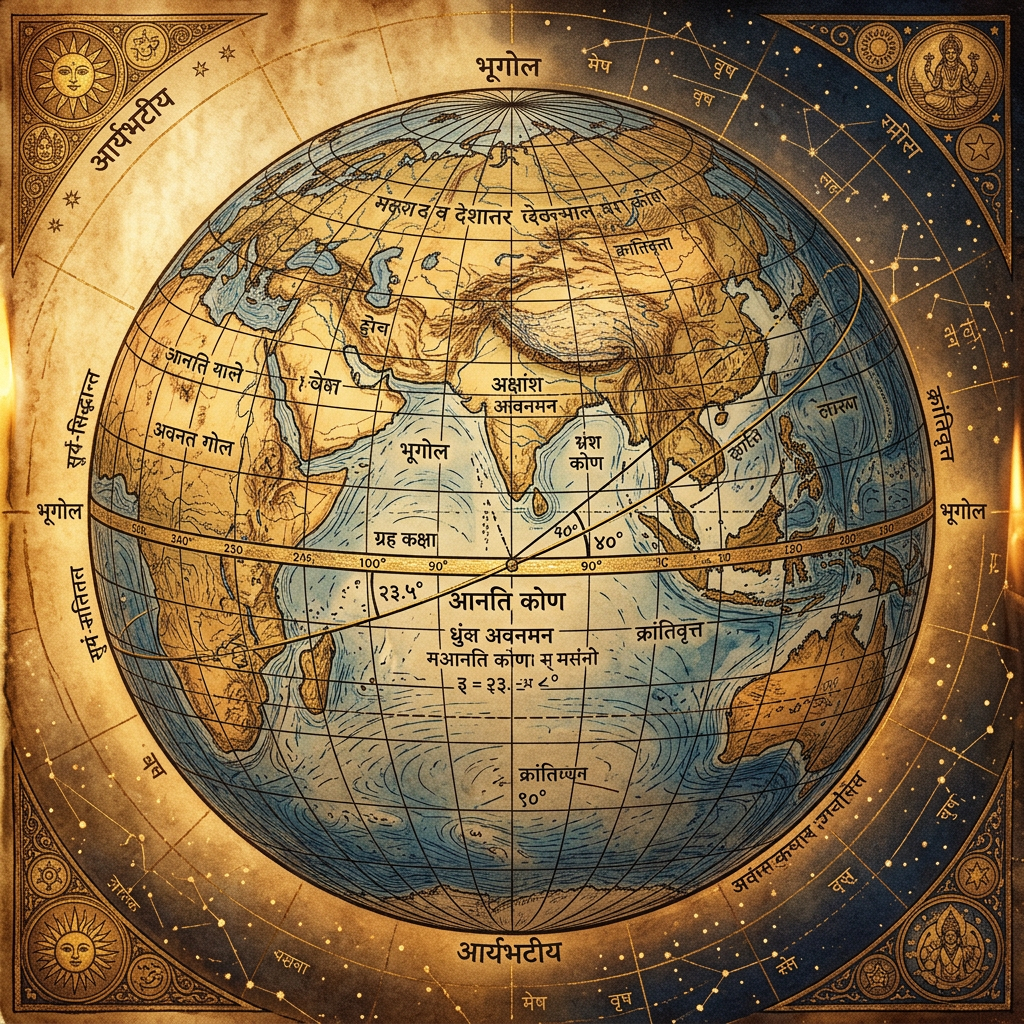
New research published in the Archeoastronomy Journal has re-evaluated the mathematical tables of Aryabhata I using advanced Bayesian statistical models. The study reveals that the 5th-century astronomer's constants for planetary orbits were adjusted to account for the Equatorial Bulge of the Earth. This suggests that Indian mathematicians had conceptualized the Earth as a non-perfect sphere, or a geoid, nearly a thousand years before European astronomers.
The modeling confirms that Aryabhata’s calculations for the Earth's circumference and the length of the sidereal year were accurate within a 0.01% margin when these geodetic corrections were applied. This research elevates the status of the Siddhantic astronomical tradition, demonstrating that it was based on a sophisticated physical model of the planet that integrated both observational data and advanced spherical trigonometry.