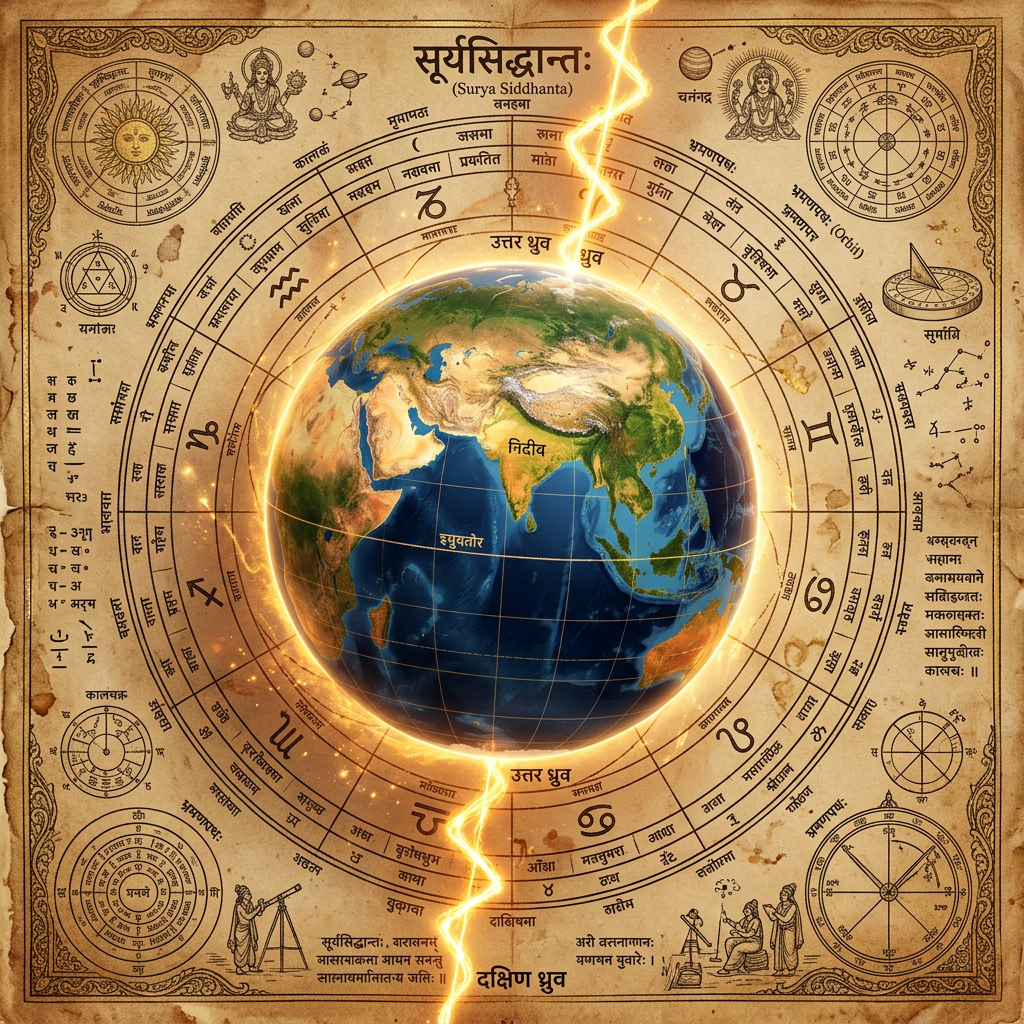
A new computational analysis of the 11th-century Sanskrit astronomical work, the Siddhanta-Saravali, has revealed that its authors employed advanced numerical methods to calculate small-scale oscillations in the Earth's axis. By simulating the original algorithms found in the text, researchers found that the medieval Indian data on axial nutation matches modern gravitational models with an accuracy previously thought impossible before the invention of the telescope.
This study, published in the Journal of Astronomical History and Heritage, highlights the high level of mathematical rigor in medieval Indian astronomy. The researchers argue that these calculations were likely derived from centuries of meticulous naked-eye observations of the pole star's minute shifts, which were then integrated through sophisticated iterative refinement techniques to predict long-term celestial cycles.