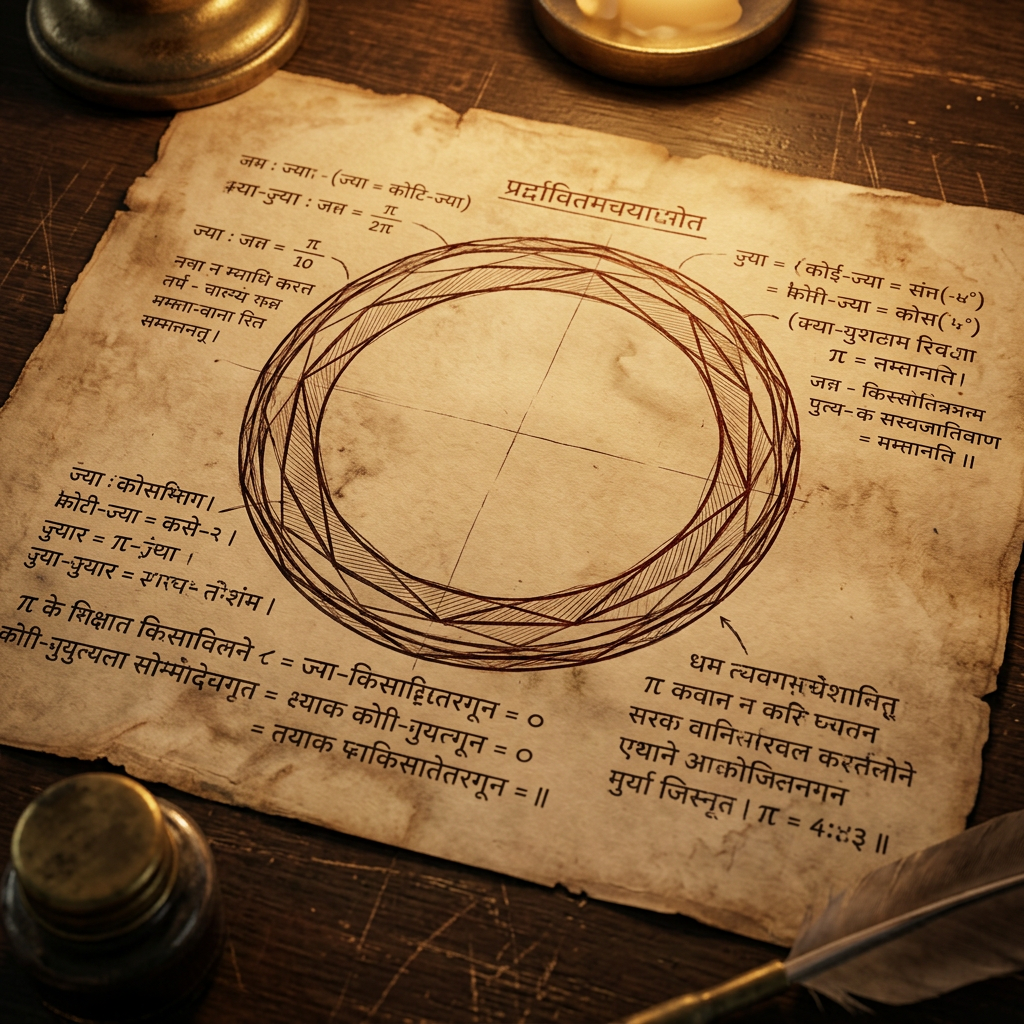
A new computational analysis of the Baudhayana Sulba Sutra, dating to approximately 800 BCE, has uncovered a sophisticated algorithmic approach to the 'squaring of the circle' problem. Unlike later Greek methods, the Sanskrit text employs an iterative process of nested polygons to reach a value for pi that is accurate to four decimal places. The study, published in the Sanskrit Science Review, demonstrates that the geometrical rituals described in the texts were based on high-level mathematical proofs rather than mere approximation.
The researchers used modern computer models to reconstruct the ritual altar constructions described in the sutras, confirming that the recursive doubling of polygon sides was used to minimize the area of error. This discovery suggests that ancient Indian mathematicians had conceptualized the idea of a mathematical limit nearly a millennium before the development of calculus. The findings place the Sulba Sutras at the forefront of global mathematical history, showcasing an early mastery of combinatorial geometry.