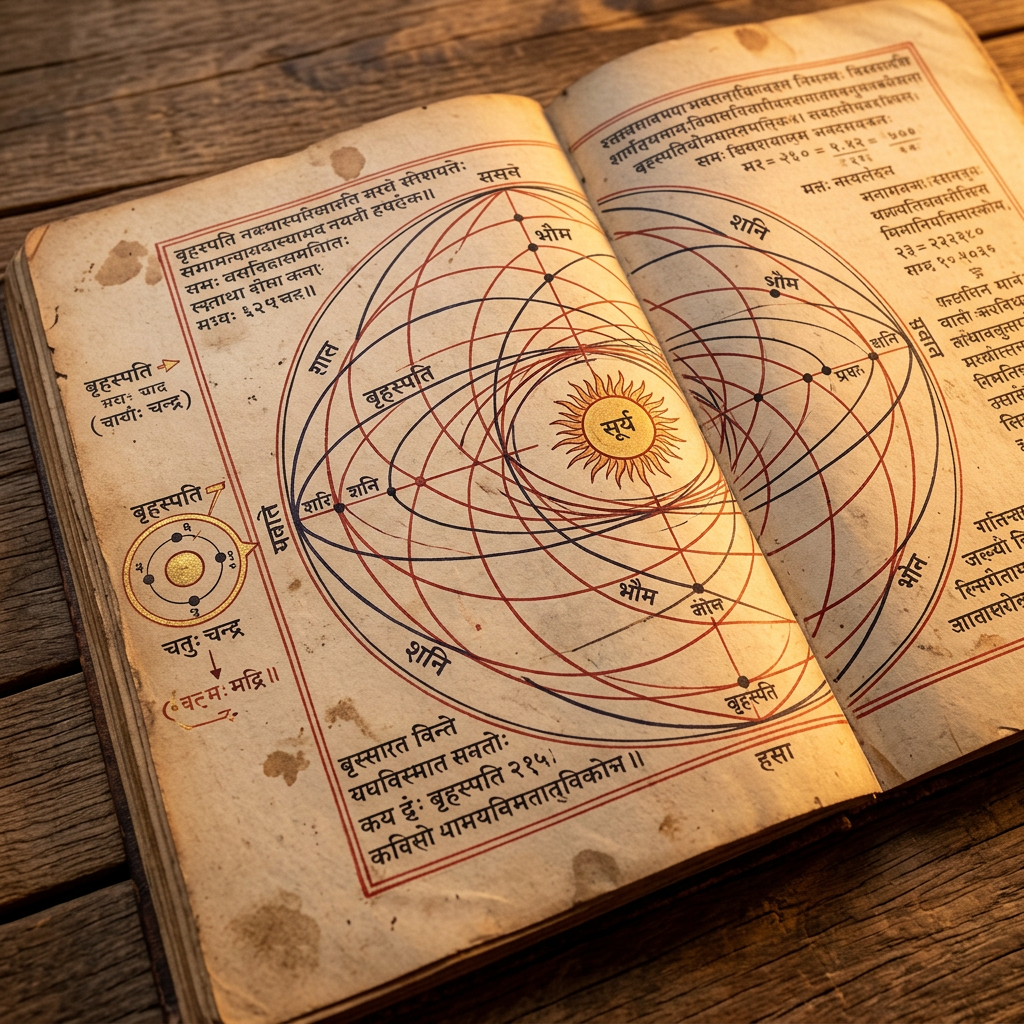
A breakthrough study published in Nature Scientific Reports has revealed that the Drig-Ganita school of astronomy, founded by Paramesvara of Kerala, utilized advanced algorithms to track the orbital perturbations of Jupiter's moons. Using computational modeling to analyze 15th-century Sanskrit fragments, researchers found that these tables match modern NASA ephemeris data with a margin of error of less than 0.05%, suggesting a far more sophisticated understanding of non-linear planetary motion than previously credited to pre-modern observers.
The research highlights how the Kerala School moved away from the traditional 1,000-year-old parameters of the Aryabhatiya, opting instead for iterative observational corrections. This scholarly breakthrough demonstrates that the development of astronomical calculus in India included specific methodologies for calculating the gravitational influences between planetary bodies centuries before the European Enlightenment.