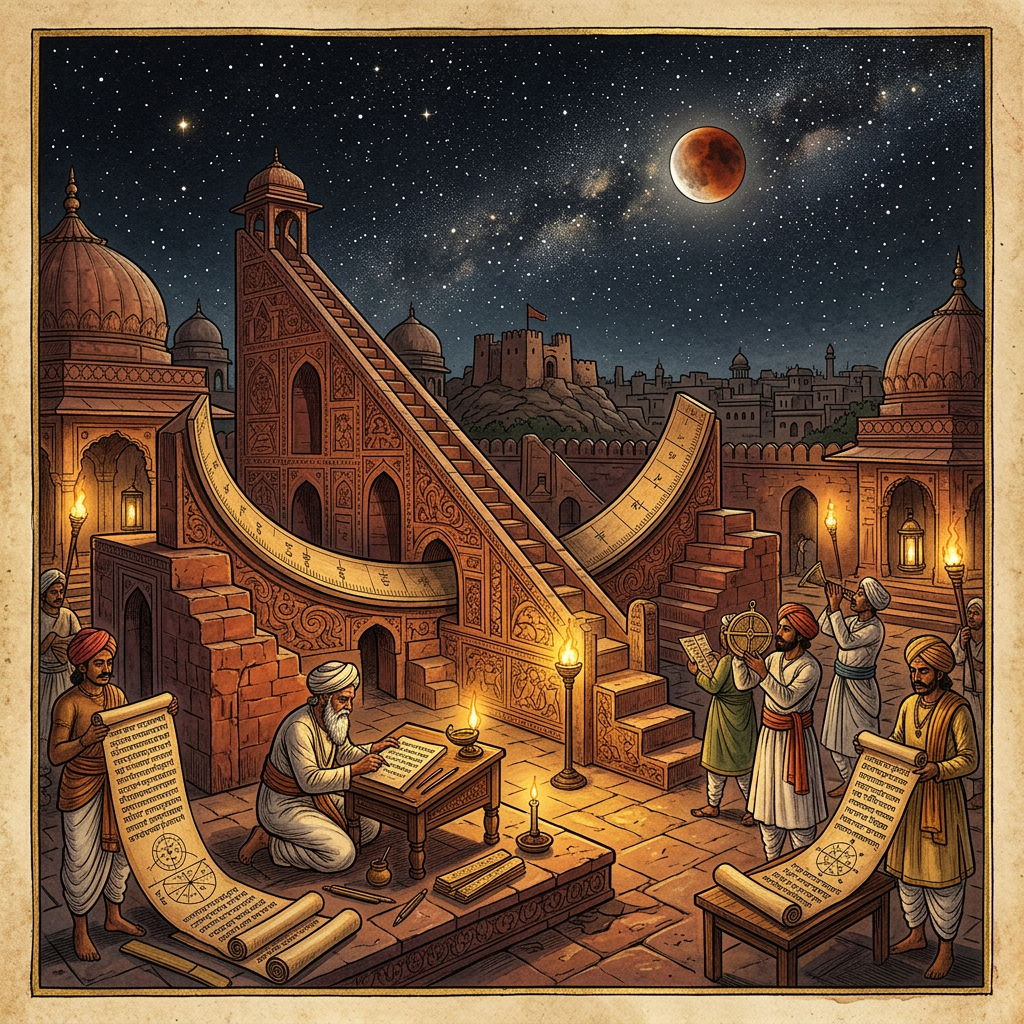
A new research paper in the Indian Journal of History of Science has validated the precision of 12th-century astronomer Bhaskara II’s calculations regarding lunar eclipses. Using modern astronomical simulations, researchers demonstrated that the algorithms found in the Siddhanta-Shiromani for calculating the diameter of the Earth's umbra (the darkest part of the shadow) are accurate to within 0.02% of current NASA satellite data. The study reveals that Bhaskara II accounted for the atmospheric refraction of sunlight long before the principle was formally recognized in Western science.
The study specifically focuses on the Gola-Adhyaya section, which provides recursive geometric formulas for predicting the duration and magnitude of an eclipse based on the observer's latitude. This research underscores the depth of Vedic astronomy and its shift toward empirical, observation-based modeling. It suggests that medieval Indian observatories were capable of measuring angular diameters with far greater sophistication than previously credited.