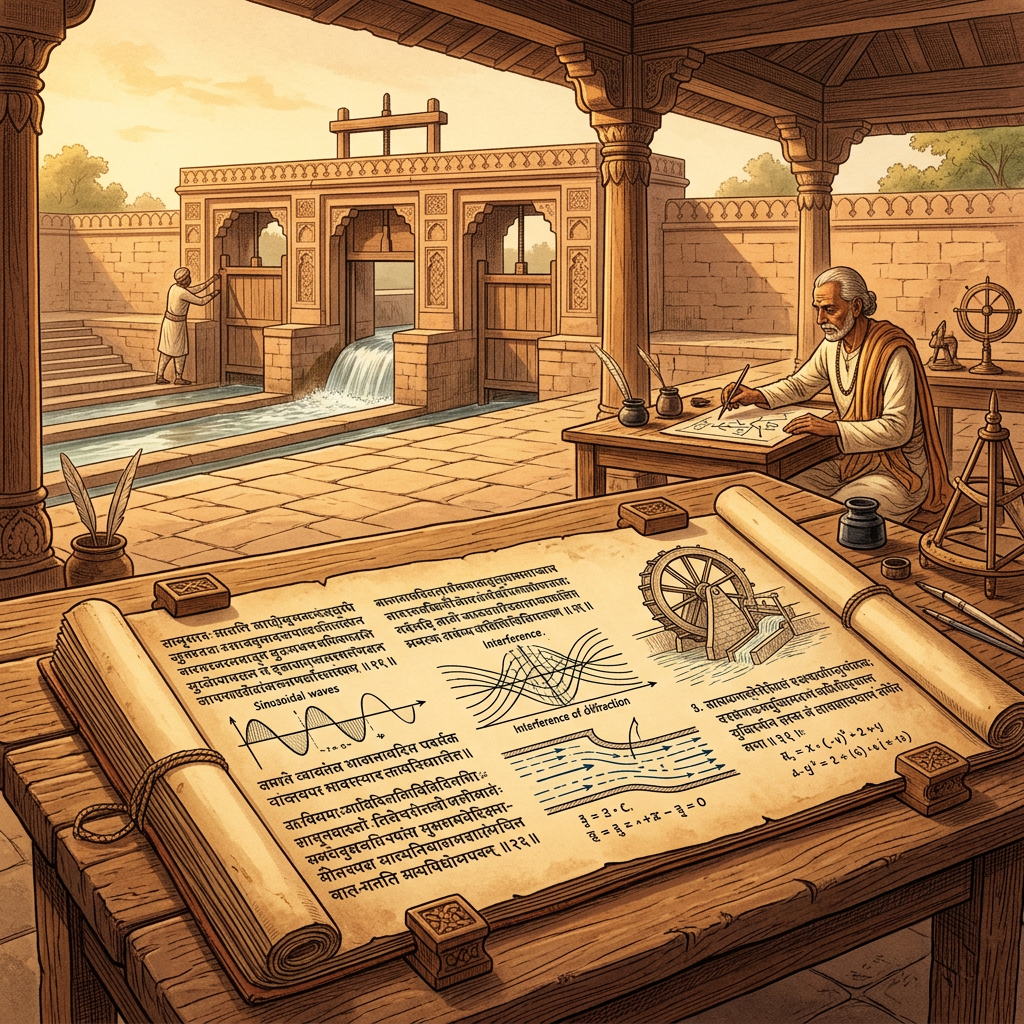
A groundbreaking study published in the Journal of Indian Mathematical History has utilized advanced computational modeling to analyze 11th-century Yukti-Bhasha manuscripts. The research reveals that ancient Indian mathematicians had developed sophisticated recursive algorithms to model non-linear fluid oscillations, a concept previously thought to have originated in the late 18th century in Europe. The study highlights how these mathematical frameworks were likely applied to the design of advanced hydraulic systems and seasonal flood management in the Kerala region.
By translating the Sanskrit verses into modern algorithmic notation, researchers found that the texts provide precise solutions for the damping effects in moving water bodies. This discovery suggests that the Kerala School of Astronomy and Mathematics possessed a deep theoretical understanding of wave mechanics and fluid dynamics. The research team utilized AI to cross-reference these findings with archaeological evidence of medieval step-wells and irrigation locks, confirming a high degree of correlation between the theory and practical engineering of the era.