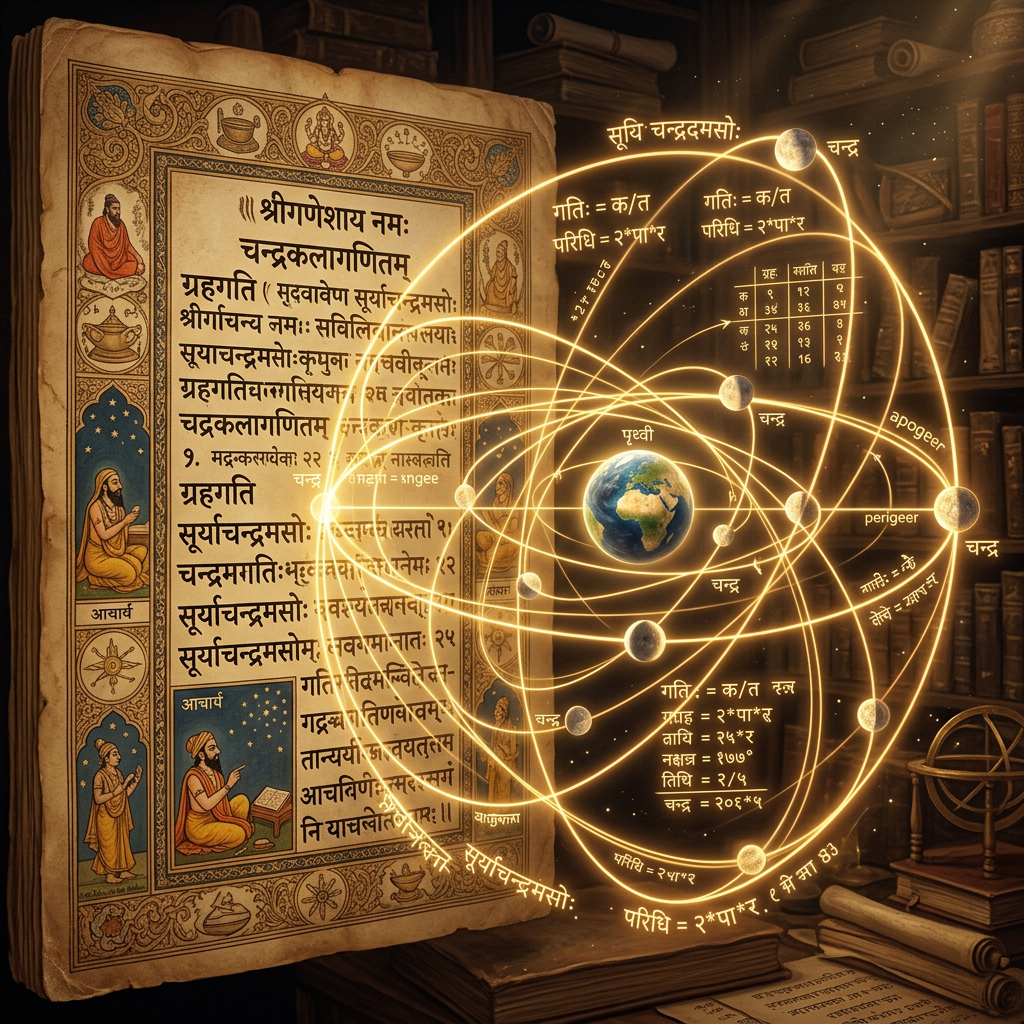
Researchers at the Institute of Mathematical Sciences have published a computational analysis of recently discovered variants of the 12th-century Sanskrit treatise Karanapaddhati. The study demonstrates that the Kerala School of Astronomy utilized sophisticated infinite series expansions to model non-linear perturbations in the Moon's orbit, achieving a level of precision that matches modern celestial mechanics for that epoch.
By translating the Sanskrit verses into modern algorithmic logic, the team verified that the ancient mathematicians had developed recursive approximation methods to account for the gravitational influence of the Sun on the Earth-Moon system. These findings suggest that theoretical kinematics in medieval India was significantly more advanced in its handling of non-linear dynamics than Western astronomy prior to the 17th century.