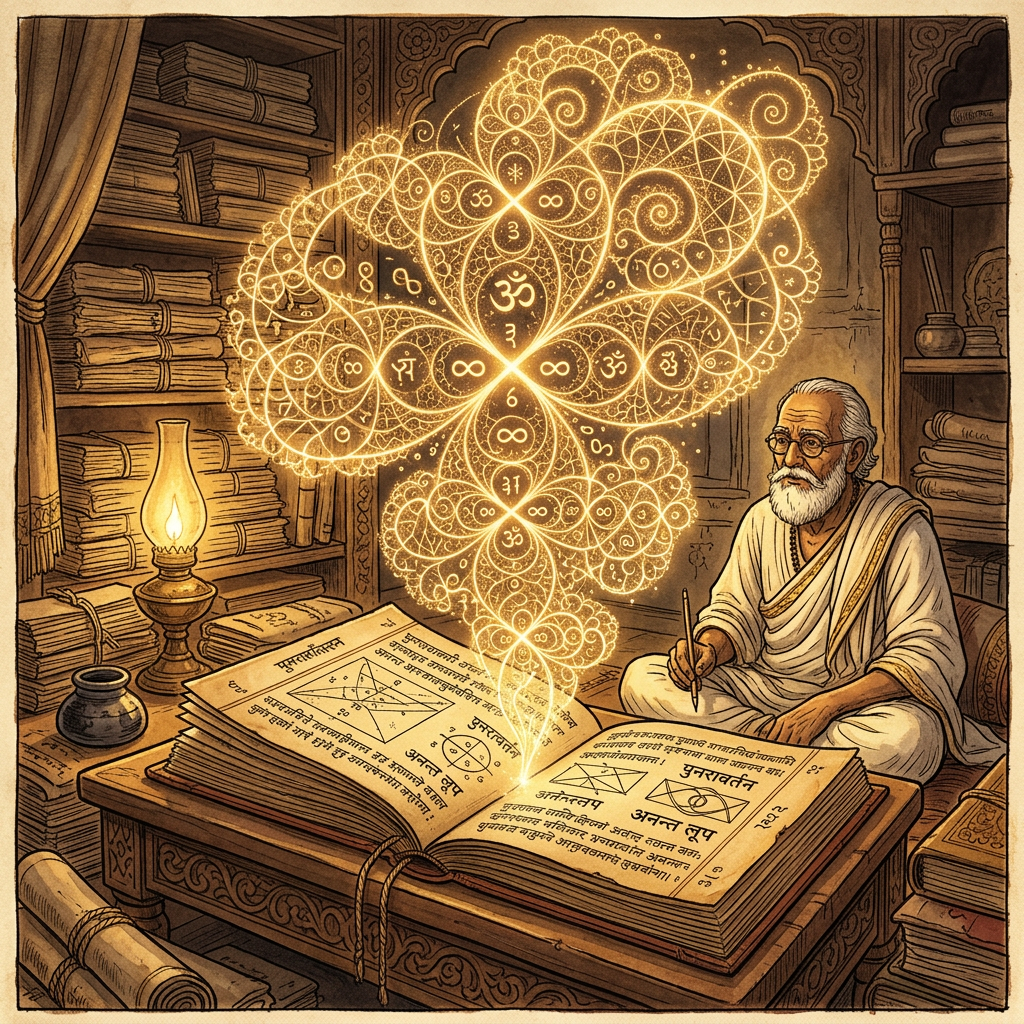
New research published in the Computational Humanities Journal has identified advanced mathematical logic within 10th-century Vijnapti-Matrata (Consciousness-Only) Sanskrit manuscripts. The study reveals that these philosophical texts utilize recursive algorithms to model complex cognitive processes, effectively predating modern theories of computational recursion by nearly a millennium.
By applying formal symbolic logic to the Sanskrit phrasing, researchers discovered that the ancient authors developed a rigorous framework for modeling non-linear cognitive feedback loops. This finding suggests that the "School of Logic" in ancient India was exploring mathematical representations of the human mind using a sophisticated proto-algorithmic language that served both theological and scientific purposes.