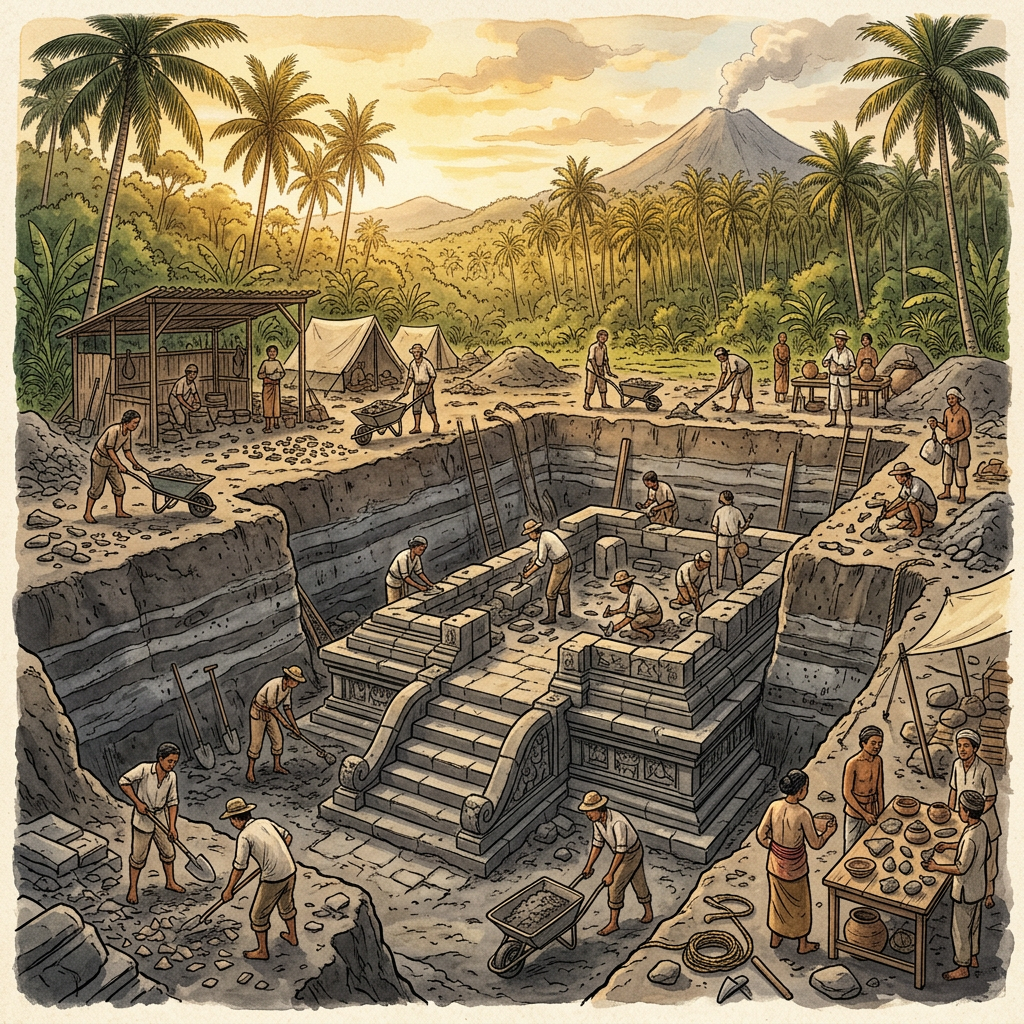
Archaeologists in Central Java have unearthed the extensive foundations of a previously unknown Hindu temple complex belonging to the 8th-century Sanjaya Dynasty. The site, buried under nearly six meters of volcanic ash from an ancient eruption of Mount Merapi, was discovered during excavation for a new irrigation project in the Sleman Regency. Initial findings suggest the temple's layout significantly differs from the nearby Prambanan complex, featuring a series of smaller peripheral shrines arranged in a unique 'grid' pattern that implies a different school of liturgical practice.
Excavations have revealed remarkably well-preserved stone pedestals and the lower tiers of a central Candi. These structures are built from high-quality andesite and feature intricate carvings of local flora and fauna, alongside traditional Shaivite iconography. Researchers believe the volcanic layer served as a protective seal, preserving the detailed masonry from centuries of weathering and looting. This discovery is expected to provide critical insights into the early transition of Hindu architecture in Indonesia before the monumental shift toward the grand styles of the later Mataram period.