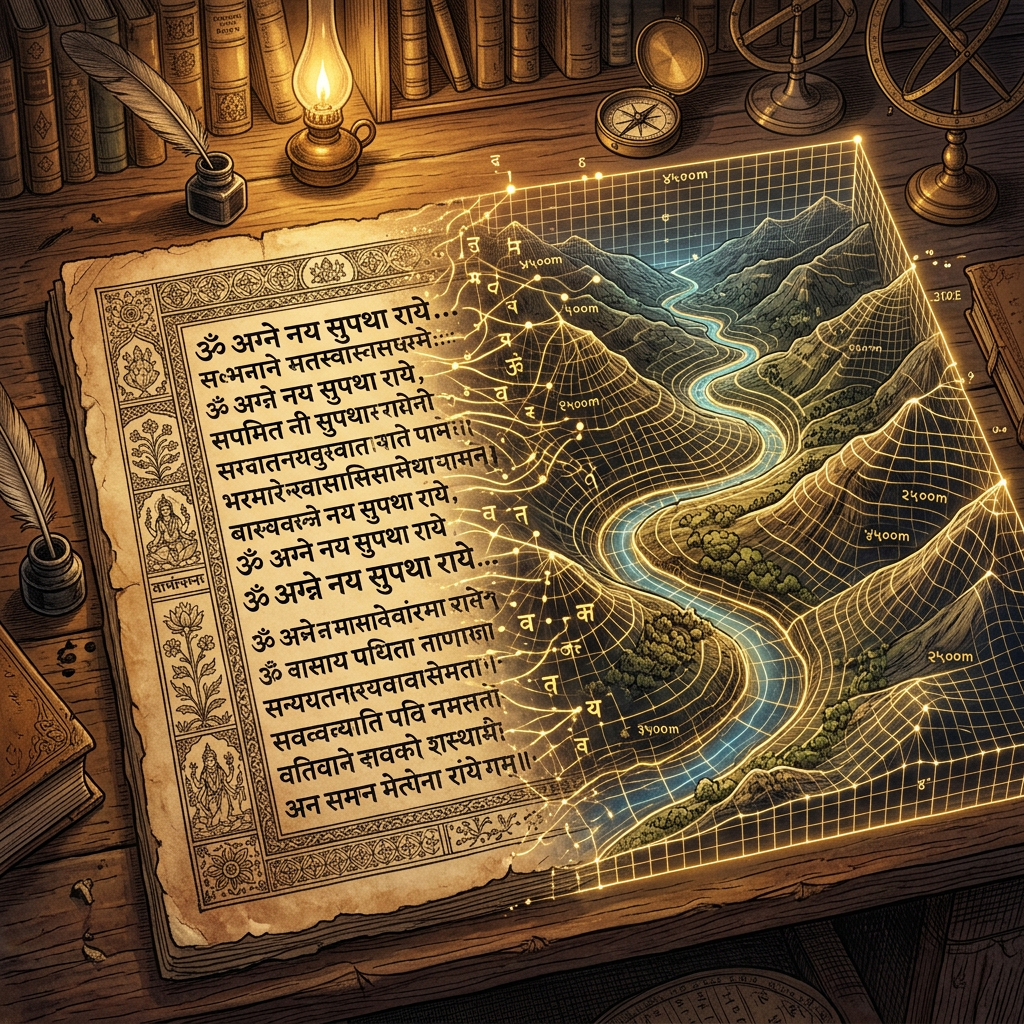
New research published in the Journal of Indian History of Science has identified a sophisticated set of algorithms within the Apastamba Sulba Sutra designed for the precise redistribution of land areas. While these texts are primarily known for ritual altar construction, computational modeling suggests that the mathematical principles were also applied to agrarian planning. The study found that Vedic mathematicians utilized a recursive method for transforming irregular quadrilaterals into equivalent squares, achieving a level of precision that predates similar European surveying techniques by nearly a millennium.
The researchers used AI to simulate the application of these ancient geometric proofs on topographically varied terrain. The results confirmed that the Sulba Sutra formulas for "circle-to-square" transformations provided a nearly perfect approximation for managing water-flow and drainage across large-scale agricultural plots. This discovery highlights the practical, engineering-oriented nature of ancient Indian mathematics and suggests that the geometry of the Vedas was deeply integrated into the management of early urban and rural landscapes in the Gangetic plain.