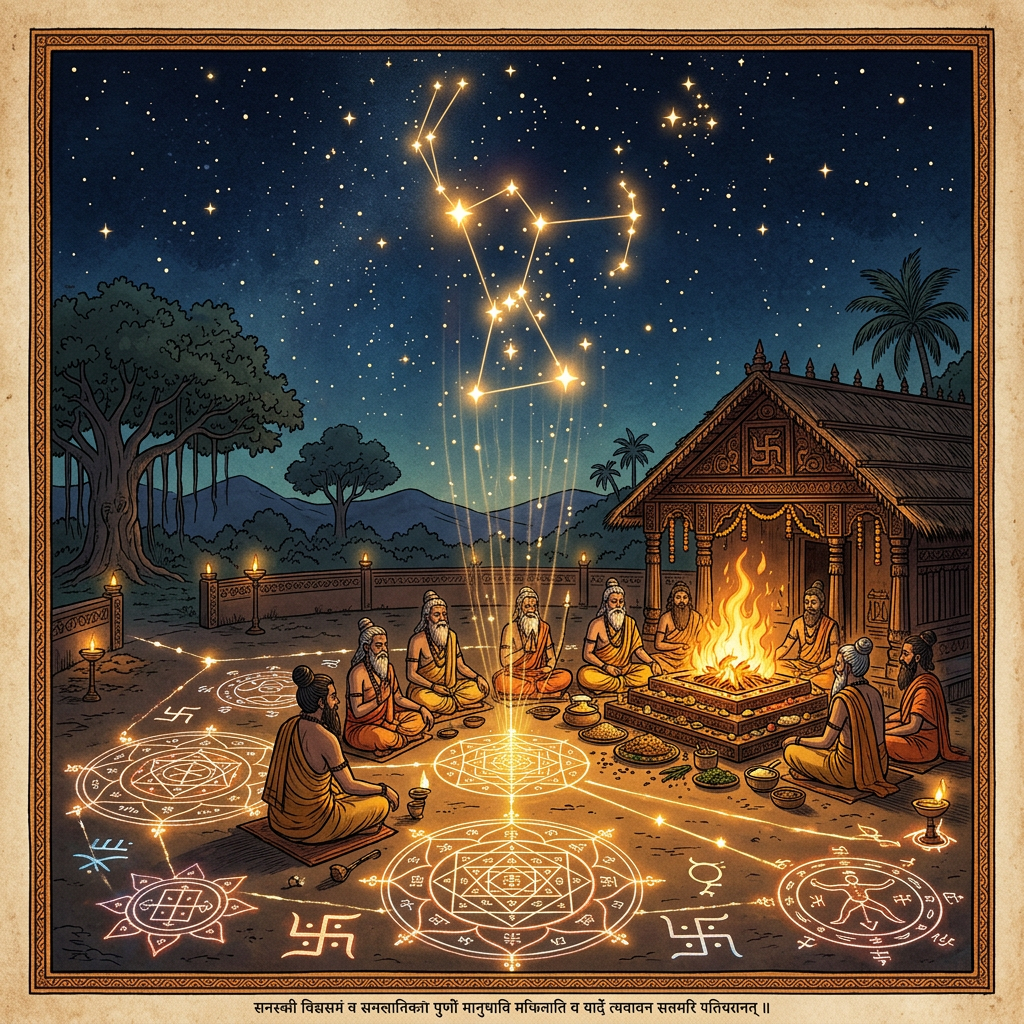
Astrophysicists and Sanskrit scholars collaborating in Astronomy & Astrophysics have published a study linking specific allegorical descriptions in the Rigveda to a rare astronomical event. By utilizing high-resolution astrophysical simulations of the Orion Nebula (M42) as it would have appeared 4,000 years ago, the team matched the "pulsating light of the cosmic hunter" mentioned in the texts with a period of intense luminosity expansion in the nebula's core around 1900 BCE. The study suggests that Vedic observers were capable of detecting subtle changes in deep-sky objects through systematic naked-eye observation.
The research demonstrates that the Rigvedic hymns often served as mnemonic devices for recording significant celestial changes. The mathematical precision of the descriptions allowed researchers to pinpoint the location and duration of the event with remarkable accuracy. This findings elevate the status of ancient Indian astronomy from myth-making to a rigorous observational science that was documenting astrophysical phenomena long before the invention of the telescope.