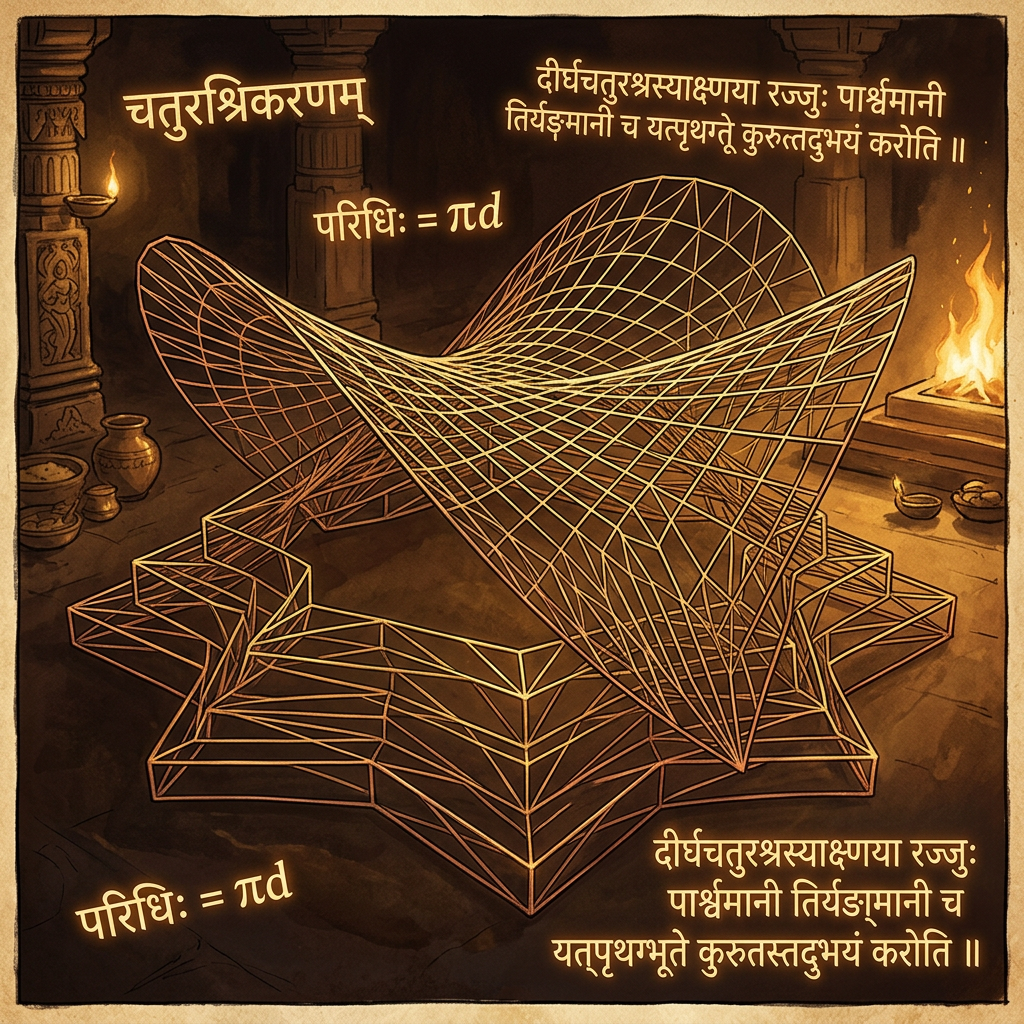
New computational analysis published in the International Journal of Vedic Mathematics has identified high-precision algorithms within the Shulba Sutras for the geometric modeling of hyperbolic paraboloids. The study demonstrates that the complex architectural layouts of certain 1st millennium BCE ritual altars were not merely symbolic but were based on rigorous mathematical proofs for calculating the surface area of saddle-shaped curvatures.
The research suggests that Vedic mathematicians utilized a precursor to recursive calculus to approximate these non-Euclidean shapes. These findings challenge the traditional history of geometry, indicating that ancient Indian architects possessed a sophisticated grasp of three-dimensional spatial dynamics far more advanced than previously recognized.