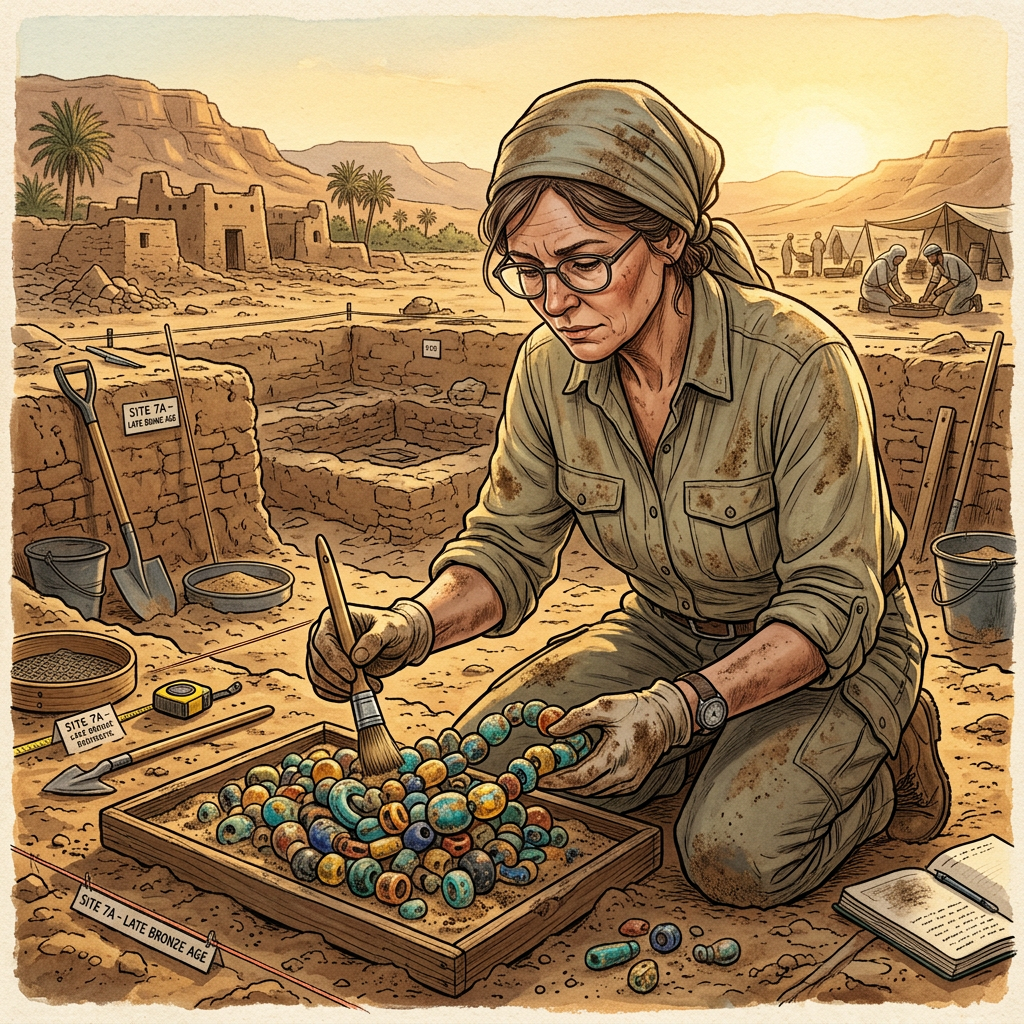
Archaeologists have identified a previously unknown trade route, dubbed the 'Glass Bead Road', which flourished between the 5th and 7th centuries CE. By analyzing the chemical signatures of thousands of dichroic glass beads found in burial sites across the Niger Delta, researchers have traced their origin to industrial glass furnaces in Byzantine Egypt. This discovery suggests a much more robust and organized trans-Saharan exchange system than previously understood for the late antiquity period.
The study reveals that these luxury items were likely exchanged for gold, ivory, and tropical resins, traversing a network of oases that pre-dates the height of the medieval Islamic trade routes. This interdisciplinary research, combining chemical isotope mapping with satellite imagery, has uncovered a series of ancient well-stations buried beneath the sands of the Libyan desert. The findings redefine our understanding of the economic complexity and connectivity of sub-Saharan African kingdoms with the Mediterranean world.