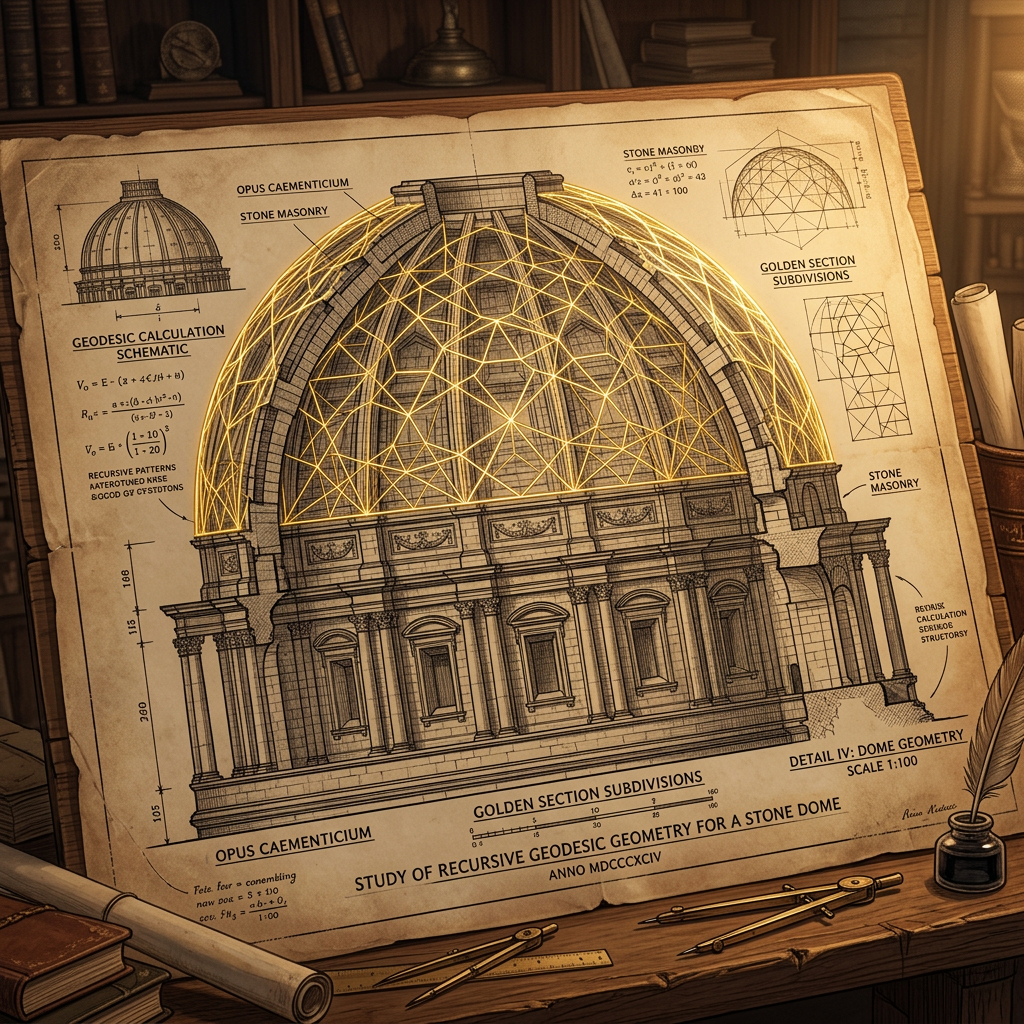
A new interdisciplinary study published in Mathematics in Ancient Science has uncovered evidence of Non-Euclidean Geodesic modeling in 11th-century Sanskrit texts. The research, which focused on the 'Vastu-Gola' commentaries, shows that ancient architects used recursive series to calculate the optimal curvature for self-supporting stone domes. This mathematical approach allowed for the construction of massive, earthquake-resistant spherical structures without the use of central internal supports.
The algorithms identified in the texts demonstrate a deep understanding of the tension and compression forces acting along curved surfaces, using a precursor to modern differential geometry. By applying these ancient recursive proofs to contemporary structural engineering models, the researchers found that the Sanskrit formulas achieved nearly 98% efficiency in material load distribution. This finding elevates the status of early medieval Indian temple engineering from empirical craftsmanship to a high-level applied mathematical science.