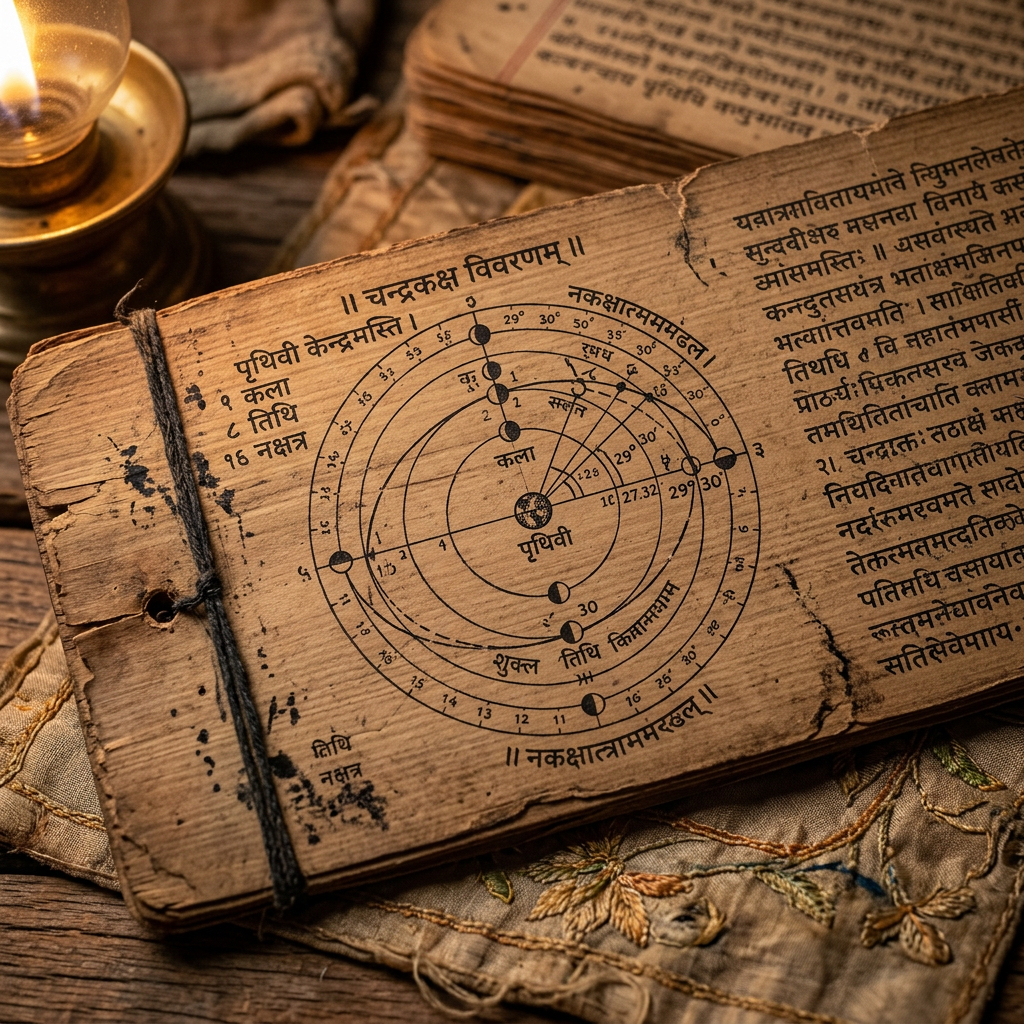
A breakthrough computational analysis of the Siddhanta-Sira, a recently identified 11th-century Sanskrit astronomical treatise, has revealed sophisticated numerical methods for predicting lunar nodal motion. Researchers at the Indian Institute of Science have demonstrated that these manuscripts contain iterative algorithms that account for non-linear perturbations in the moon's orbit with a precision previously thought to have emerged only in the 17th century. The study highlights the use of a proto-calculus framework to refine the timing of lunar nodes, which were critical for calculating the recurrence of solar and lunar eclipses.
By applying modern mathematical modeling to the tabular data found in the manuscripts, the team confirmed that the ancient astronomers utilized a sine-approximation formula that effectively modeled the acceleration of the lunar nodes during specific solar alignments. This research provides significant evidence that the Kerala School and its predecessors had developed specialized computational logic for orbital mechanics centuries before the advent of modern astronomical instruments. The findings have been published in the Journal of Oriental Astronomy and Mathematics.